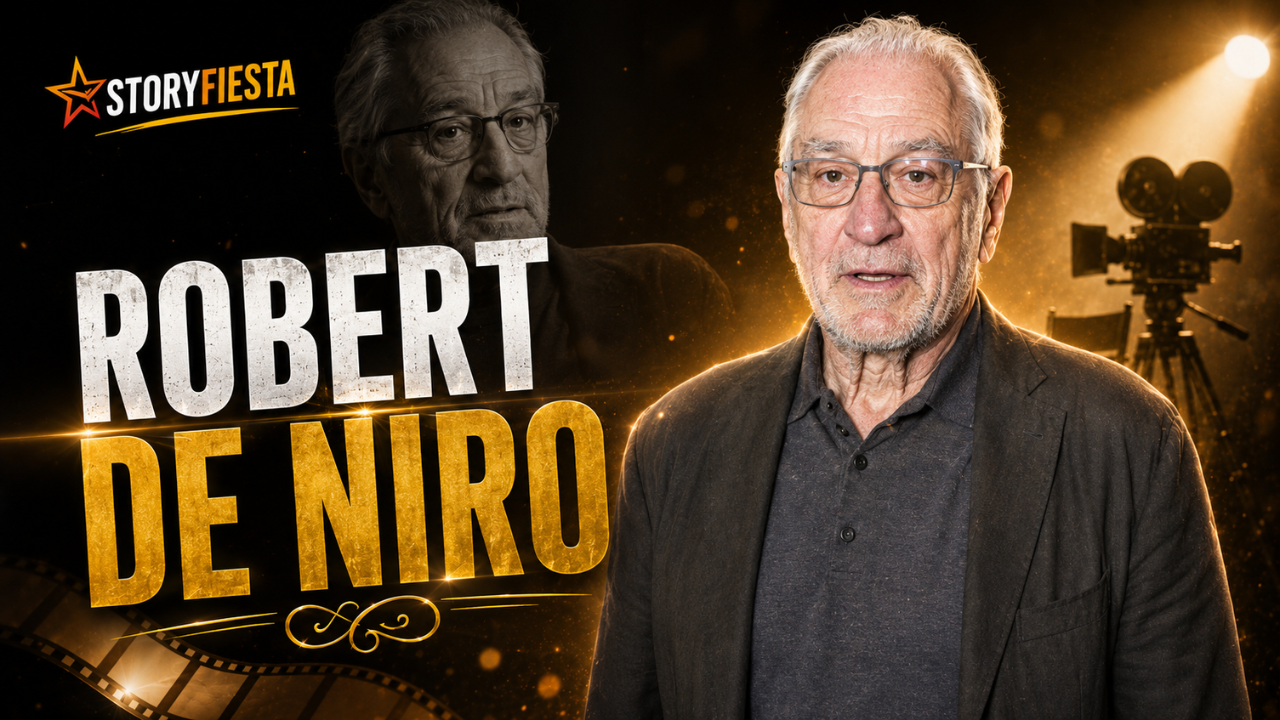
Robert De Niro’s public record extends beyond his performances on screen. Born in New York City on August 17, 1943, he developed a career that includes acting, directing, producing, cultural work, and long-term involvement in the recovery and creative life of lower Manhattan.
His work has brought major institutional recognition, including two Academy Awards, the Kennedy Center Honors, the Presidential Medal of Freedom, and the SAG Life Achievement Award. Outside production work, he helped establish the Tribeca Festival after the September 11 attacks, donated extensive professional materials for academic research, and participated in charitable and civic projects.
Acting Became a Way to Express Himself
De Niro has described acting as an early means of personal expression. In a 2006 interview with GQ, he recalled that a teacher once suggested he become an actor because it would give him a way to express himself. De Niro accepted that explanation, although he did not discuss the deeper personal reasons behind his choice.
He also acknowledged that he did not begin his career with strong confidence. His confidence developed through experience rather than appearing fully formed at the start. These comments provide a limited but direct account of how he understood his early professional development.
During the same GQ interview, De Niro asked for the recording equipment to be turned off because he believed the conversation would be easier without it. The request documented his preference in that particular setting rather than a fixed attitude toward every interview or public appearance.
His later comments suggest that experience also changed how he approached uncertainty. Speaking to AARP in 2024, he said he had learned not to place excessive mental pressure on himself by worrying unnecessarily. Instead, he preferred to let events develop without exhausting himself by trying to anticipate every outcome.
Recognition Across Acting, Directing, and Producing
The Academy of Motion Picture Arts and Sciences lists 9 nominations for Robert De Niro. Eight are acting nominations, while one came through his role as a producer of The Irishman, which received a Best Picture nomination.
He won the Academy Award for Best Supporting Actor for The Godfather Part II and later won Best Actor for Raging Bull. Older institutional biographies sometimes identify him as a seven-time nominee, but those profiles were published before his later acting and producing nominations. The Academy’s current database records the updated total.
De Niro expanded his creative work by taking on directing roles. He directed A Bronx Tale and returned to directing 13 years later with The Good Shepherd. He explained that the long gap resulted from several factors rather than one deliberate decision. Directing was demanding; the earlier project had not delivered significant commercial encouragement; no suitable new project had immediately emerged; and acting commitments had interrupted his momentum.
While completing The Good Shepherd, he spoke openly about the anxiety and difficulty involved in directing. His remarks concerned that specific period and project, but they offer a direct view of the pressure he experienced while managing responsibilities beyond his acting role.
Recognition for his broader contribution continued outside the Academy Awards. In 2009, the Kennedy Center recognized him as one of its distinguished honorees. President Barack Obama presented him with the Presidential Medal of Freedom on November 22, 2016. SAG-AFTRA later selected him as the 56th recipient of its Life Achievement Award, which he received in January 2020 for his career and humanitarian accomplishments.
Working Methods and Major Career Decisions
De Niro’s comments about Martin Scorsese provide insight into one of his most important professional collaborations. In a 2024 AARP interview, he explained that Scorsese does more than give actors ordinary instructions. In De Niro’s account, the director coordinates and adjusts performances in ways that allow actors to work with confidence rather than constantly fearing an incorrect choice.
Practical considerations have also shaped his decisions. When discussing his first starring television-series role, De Niro said he and his agent had been considering a project that would let him work in New York and remain closer to home. He accepted Zero Day after receiving material that he considered strong and believable.
The project represented a change in format: De Niro starred in the Netflix series and served as an executive producer, making it his first television series in which he held both responsibilities.
He has also rejected the idea that professional activity must automatically give way to conventional retirement. In a May 2024 interview with Entertainment Tonight, he said he preferred to remain active and saw no reason to replace acting with activities such as golf. His comment expressed his position at that time rather than setting a fixed timetable for future work.
Tribeca Began as a Response to Lower Manhattan’s Crisis
The Tribeca Festival developed from the conditions facing lower Manhattan after the September 11, 2001 attacks. De Niro, Jane Rosenthal, and Craig Hatkoff began creating the event as part of an effort to bring audiences, businesses, and cultural activity back downtown.
The dates attached to Tribeca describe different stages of its development. Planning began in 2001, the first festival took place in 2002, and Tribeca Enterprises was established in 2003. These dates refer to separate stages: the festival’s planning period, its first public edition, and the later establishment of Tribeca Enterprises.
De Niro has described the festival as a civic response to the crisis rather than simply an industry event. He believed screenings and public programs could encourage people to return to the area at a time when lower Manhattan needed both economic activity and a renewed sense of public connection.
The festival’s purpose therefore combined storytelling with place. Its founders were building a cultural event while responding to the economic and cultural disruption affecting lower Manhattan after the September 11 attacks.
Building a Lasting Place in New York’s Cultural Life
Tribeca developed from an emergency response into an established annual festival. De Niro said he wanted it to become part of New York City’s cultural fabric rather than remain a temporary reaction to a single period.
His support for the festival is closely connected to his belief in shared viewing experiences. In a 2026 GQ interview, he said watching a film in a large theater with strangers creates a different atmosphere from viewing it at home. The reactions of an unfamiliar audience become part of the experience.
De Niro acknowledged that viewing habits changed significantly, particularly during and after the COVID-19 pandemic, but he remained optimistic about the survival of theaters. That position represented his professional belief rather than a prediction based on industry statistics.
The festival reached its 25th edition from June 3 through June 14, 2026. Official anniversary programming included a scheduled conversation with De Niro and Rosenthal about Tribeca’s origins, risks, development, and connection to New York. The anniversary program also named them as presenters of the Founders Award.
The official plans placed De Niro in Tribeca’s anniversary programming through the scheduled conversation and Founders Award presentation.
Public Work Beyond Screen Performances
De Niro has made a substantial part of his professional archive available for scholarly study. In 2006, he donated papers and production materials to the Harry Ransom Center at the University of Texas at Austin. The collection opened to researchers and the public in 2009.
Its holdings include scripts, correspondence, research, costumes, props, makeup materials, production records, and electronic files. The archive has expanded to cover work through 2023. Earlier reports listed more than 1,300 boxes, while the current finding aid organizes the expanded collection into several categories, so those figures are not directly comparable.
Robert De Niro and his daughter Drena are also publicly associated with the Leandro De Niro Rodriguez Foundation. Created in Leandro’s memory, the 501(c)(3) charity states that it supports young people and families affected by substance-use disorder and dangerous drugs.
Its stated areas of work include prevention, treatment, recovery, family assistance, the arts, and arts education. The official website confirms the foundation’s purpose and its association with Robert and Drena De Niro. However, it does not clearly identify a launch date or provide enough information to claim specific grant totals or measured outcomes.
De Niro has also used public appearances to discuss artistic freedom and civic responsibility. During his acceptance speech for the Honorary Palme d’Or at Cannes in May 2025, he connected freedom in the arts with democratic participation. He encouraged peaceful civic action, including organizing, protesting peacefully, and voting.
Recent Work and International Recognition
Netflix released Zero Day on February 20, 2025. It marked De Niro’s first starring television series role and his first series in which he combined that role with executive-producing duties.
One month later, Warner Bros. released The Alto Knights on March 21, 2025. De Niro played two leading characters in the production, adding a dual performance to his recent work.
The Festival de Cannes honored him on May 13, 2025, with an honorary Palme d’Or for lifetime achievement. The recognition was not a competitive award for one film or performance. Cannes also scheduled a public masterclass with him for the following day.
In May 2026, De Niro said he hoped to make at least one more project with Martin Scorsese. His comment expressed continued creative interest, but it was not an official production announcement. No title, screenplay, financing, casting, or schedule was confirmed.
A Legacy Connecting Screen Craft With Civic Purpose
Robert De Niro’s verified record covers more than a long acting career. It includes directing and producing, major awards from cultural and government institutions, a professional archive made available to scholars, and recent work across film and television.
Tribeca remains central to the wider picture. What began after September 11 as an effort to draw people and activity back to lower Manhattan developed into a lasting New York cultural institution. De Niro’s continuing involvement has linked his screen career with public support for theaters, independent storytelling, artistic freedom, and civic participation.
His work with the Harry Ransom Center and the Leandro De Niro Rodriguez Foundation adds further dimensions to that record through education, access to research, prevention, recovery, and arts-related support. Alongside his recent performances and international recognition, those projects explain why his public contribution cannot be measured through acting credits alone.
Fact-checking note: This profile is based on information confirmed through the verified sources examined during the research. Unsupported and unconfirmed claims were excluded.