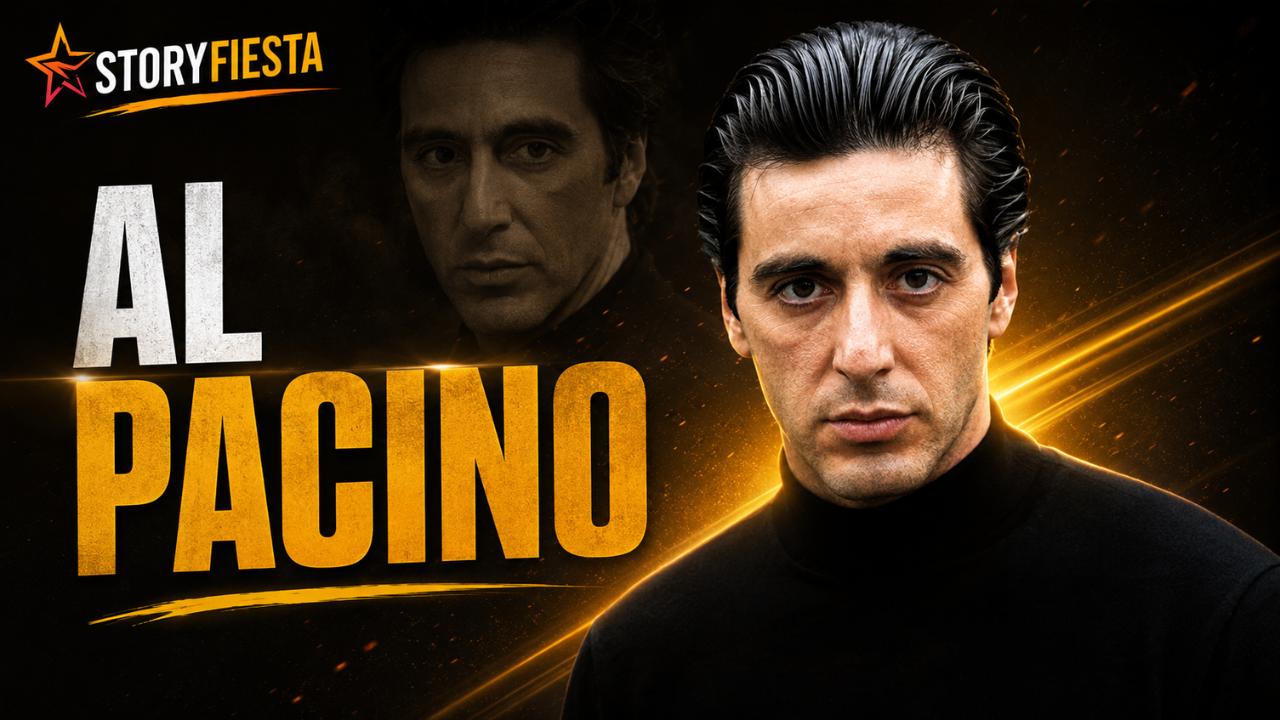
Al Pacino’s public story reaches far beyond a single famous performance. Born in East Harlem and raised mainly in the South Bronx, he developed an early interest in acting through visits to the cinema with his mother, encouragement from a schoolteacher, and formal study under respected acting mentors. His later achievements included major recognition across theatre, film, and television, but his connection with acting institutions remained equally important.
Pacino’s career also includes decades of service at the Actors Studio, where he once trained and later became a co-president. In interviews, Pacino has discussed the mentors who shaped him, the pressures of fame, fatherhood, sobriety, disciplined preparation, and why acting remains meaningful to him.
East Harlem Birth and South Bronx Upbringing
Al Pacino was born in East Harlem in 1940, although much of his childhood was spent in the South Bronx. His parents separated before he was two, and he initially lived with his mother in furnished rooms in Harlem. They later moved into his maternal grandparents’ apartment.
The difference between his birthplace and upbringing is important. East Harlem is identified as his birthplace, while the South Bronx provided the setting for many of his formative experiences. He grew up mainly within a household led by his mother and grandparents rather than with his father’s regular presence.
Pacino remembered that his mother introduced him to cinema by taking him to films when he was only three or four. After returning home, he would remember the characters he had seen and perform them inside the apartment. These performances were among Pacino’s earliest remembered experiences of acting.
A more direct push toward acting came from his eighth-grade teacher, Blanche Rothstein. Pacino later told CBS News that she visited his family and encouraged them to support his ability. He did not know exactly what she told his grandmother, but he regarded her intervention as an important turning point.
Training, Mentorship, and Early Theatre Development
Pacino’s development continued through formal study at the Herbert Berghof Studio, where he worked with Charles Laughton. He continued developing his craft through training with Lee Strasberg at the Actors Studio. These institutions provided Pacino with formal acting training under Charles Laughton and Lee Strasberg.
Charles Laughton became more than an instructor. Pacino has described him as an important mentor who supported him through periods of uncertainty. At that stage, acting offered little financial stability, so Pacino took various jobs while pursuing his training and performances.
Reading also became part of his education. Pacino recalled that books were a constant companion throughout the challenging years of his early adulthood. He credited Laughton with introducing him to important writers and helping him build an intellectual foundation outside conventional academic routes.
That combination of training, mentorship, and self-education shaped his early professional direction. He did not move directly from childhood interest to widespread recognition. His progress came through study, theatre work, unstable employment, and repeated opportunities to develop his technique.
Theatre Success Before Wider Recognition
Pacino achieved major recognition in theatre before becoming internationally associated with screen acting. In 1969, he won the Tony Award for Actor in a Featured Role in a Play for Does a Tiger Wear a Necktie?
Eight years later, he received another Tony Award, this time for Actor in a Play for The Basic Training of Pavlo Hummel. The two victories confirmed his standing in theatre across different stages of his early career.
Pacino has continued to describe theatre as a particularly demanding form of acting. Unlike screen work, a stage performance unfolds before a live audience and must be rebuilt each time. For him, the audience becomes part of the event, changing the pressure and energy of each performance.
He has also spoken about theatre as a place for continued development. Even after receiving major honors, he viewed stage work as a way to challenge himself rather than repeat familiar methods. That attitude remained tied to his belief that an actor could continue to improve long after achieving public success.
The Role That Changed His Career
Pacino reached a defining career moment when Francis Ford Coppola cast him as Michael Corleone in The Godfather. Pacino has said that the studio had serious reservations about casting him, while Coppola remained committed to the choice.
The production was released in 1972 and transformed Pacino’s professional position. The change was not simply a matter of receiving more work. He moved quickly from a developing theatre and screen actor to a person recognized on a much larger scale.
In later interviews, Pacino described sudden fame as difficult to understand and manage. He told CBS that people have to learn how famous they have become, adding humorously that he was still trying to understand it. In an earlier conversation with The New Yorker, he described the speed of change during the 1970s as overwhelming.
Pacino’s comments describe the difficulty of adjusting to the sudden public recognition that followed his career breakthrough.
Recognition Across Film and Television
Pacino’s work later received official recognition across several major institutions. At the 1993 Academy Awards, he won Best Actor for Scent of a Woman. The film had been released in 1992, which explains why some biographies describe it as his 1992 Oscar, but the award itself was presented on March 29, 1993.
At that same ceremony, he was nominated for Actor in a Supporting Role for Glengarry Glen Ross. His later supporting-actor nomination for The Irishman, announced in January 2020, brought his verified total of Academy Award nominations to nine.
His television record includes three Emmy nominations and two wins. The Television Academy records victories for Angels in America in 2004, and You Don’t Know Jack in 2010, followed by another nomination for Phil Spector in 2013.
Pacino also received recognition for his broader contribution to performance. The American Film Institute named him its 35th Life Achievement Award honoree in 2007. The United States later recognized his contributions to film and theatre with the 2011 National Medal of Arts, presented at the White House on February 13, 2012.
These records cover different parts of his profession: stage, film, television, acting, and directing. They also show that his career was not confined to a single period or performance format.
Acting as Purpose and Continued Growth
Pacino has often described acting in personal rather than ceremonial terms. In interviews, he said acting had saved his life and helped him make sense of his experiences. He described acting as a source of purpose that continued to motivate his work after extensive professional recognition.
His preparation has included close attention to how people move, stand, dress, and respond. Named collaborators have described his observation of physical behavior, while Pacino himself has discussed the demands of building a performance through repeated work.
He told The New Yorker in 2014 that he continued acting because he did not believe he had fully reached his stride. At that point in his career, he still saw room for development and considered theatre a place where difficult material could continue to test him.
Personal struggle also formed part of his account. Pacino said that frightening memory blackouts contributed to his decision to stop using alcohol and drugs. He attended Alcoholics Anonymous for a time but said its approach did not ultimately suit him. He again credited Charles Laughton with providing important support.
Pacino has described himself as sober for more than four decades. The New Yorker placed the end of his drinking in 1977, although that exact year comes from the publication’s account rather than a dated treatment or medical record.
Fatherhood, Memory, and Personal Reflection
Pacino has said that fatherhood changed him permanently by directing his attention and love toward his children. He has four children and has connected his desire to remain involved in their lives with his own experience of growing up without his father’s regular presence.
His reflections on his mother also changed with time. As a child, he resented being kept indoors on school nights. Looking back, he came to believe that her strict protection helped distance him from drugs and other dangers affecting some of his childhood friends.
That view represents Pacino’s later interpretation of his upbringing rather than proof of what would otherwise have happened. Even so, it adds useful context to his understanding of parental responsibility and protection.
Advancing age influenced his decision to write his memoir, Sonny Boy. Pacino said he wanted to preserve an account of his experiences for the people close to him, including his children. Penguin Random House published the memoir in hardcover, ebook, and audiobook formats on October 15, 2024, and Pacino narrated the audio edition himself.
The book presents Pacino’s own memories of his childhood and career, while award dates and official positions are documented separately by the relevant institutions.
Leadership at the Actors Studio
Pacino’s relationship with the Actors Studio developed from student to institutional leader. After studying there with Lee Strasberg, he later entered its senior leadership and began serving in a presidential role in 1995.
From 1995 to 2017, he served alongside Ellen Burstyn and Harvey Keitel. Since 2017, the Actors Studio has listed Pacino as a co-president with Ellen Burstyn and Alec Baldwin.
The position connects his early training with his later professional service. He has remained part of the Actors Studio’s official leadership structure for decades.
The official Actors Studio record verifies Pacino’s enduring leadership role without detailing his regular duties. No separate current advocacy program directed by him is documented in the verified information.
Continuing Work and Recent Developments
Pacino’s recent verified activity includes both publishing and screen work. A paperback edition of Sonny Boy was published on May 5, 2026. It was a new edition of the 2024 memoir rather than a separate second book.
He also appeared among the confirmed cast of Dead Man’s Wire. The distributor recorded an awards-qualifying run beginning on December 12, 2025, followed by a limited release on January 9, 2026, and a wider North American release on January 16.
The available distributor information confirms Pacino’s participation but does not define the size of his role or provide detailed production dates. It nevertheless establishes the project as a released work rather than an unverified casting report.
The Actors Studio continued to list Pacino as a co-president on its leadership page, although the page did not state when it was last updated.
Conclusion
Pacino’s progress was shaped by sustained training, influential mentors, theatre experience, and a professional connection with the Actors Studio that eventually developed into long-term leadership.
His later record includes Tony Awards, an Academy Award, Emmy victories, the AFI Life Achievement Award, and the National Medal of Arts. Yet his long-term role at the Actors Studio adds another dimension to that record. The institution where he trained later became a place where he served in leadership for more than three decades.
Pacino’s own reflections describe acting as a source of purpose, fatherhood as a lasting change in responsibility, and continued work as an opportunity for growth. His memoir, recent screen activity, and ongoing Actors Studio position present a verified picture of a career still connected to performance, memory, and professional service.
Fact-checking note: This profile draws only from verified sources examined during the research process. Unsupported and unconfirmed claims were excluded.