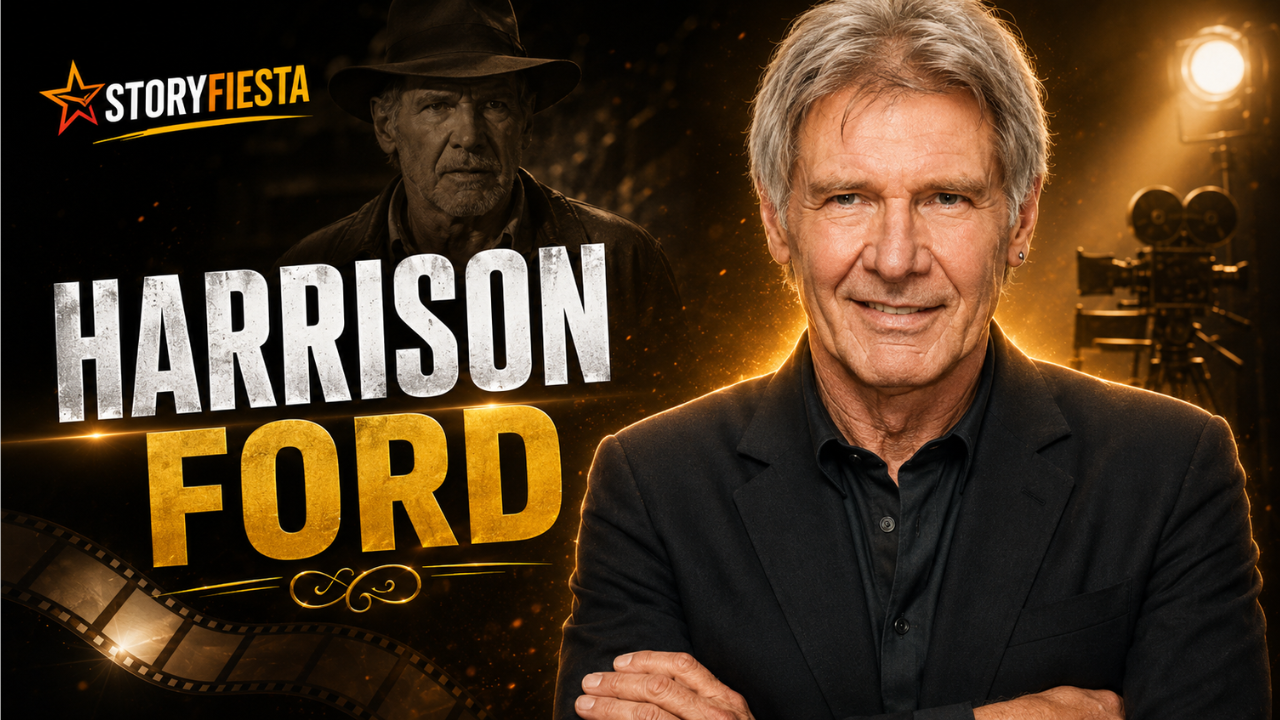
Harrison Ford built a long screen career while maintaining a separate commitment to conservation, environmental advocacy, and public service. His professional path was neither immediate nor predictable. He spent years taking limited acting opportunities while supporting his family through carpentry, then moved into roles that brought international recognition.
His work beyond acting developed gradually and became a long-term commitment in its own right. Ford joined Conservation International’s board in 1991 and later served in a senior leadership role. He also used his aviation experience in youth programs and public-service initiatives. By 2026, his record included continued television work, major institutional honors, and more than three decades of environmental involvement.
A Long Route From Carpentry to Major Roles
Ford began professional acting work during the 1960s, but steady success did not follow quickly. He later recalled a long period in which he worked as a carpenter and secured only a small number of acting opportunities that he considered promising. Carpentry provided dependable income while he continued trying to develop his acting career.
The familiar account that Ford had abandoned acting and was discovered by accident while working as a carpenter omits important context. In his own account, he was still pursuing acting when he worked at Francis Ford Coppola’s offices and was asked to read lines with performers auditioning for Star Wars. That opportunity placed him in the casting process, but it came after years of professional uncertainty rather than a sudden change of direction.
His appearance in American Graffiti in 1973 preceded his international breakthrough as Han Solo in Star Wars in 1977. These performances brought Ford greater recognition, though he has never portrayed his success as a guaranteed result. In later interviews, he credited learning, persistence, circumstance, and unusual good fortune.
Building a Career Around Varied Performances
Although Ford became widely associated with major leading roles, he said his original ambition was to become a character actor. He was interested in playing different kinds of people rather than remaining confined to a single version of the conventional leading man. That preference helps explain why he continued taking roles across different formats and stages of his career.
His dramatic work in Witness earned him an Academy Award nomination for Best Actor at the ceremony held on March 24, 1986. The nomination remains his officially recorded recognition in that category; William Hurt received the award that year.
Institutional honors later recognized the wider span of Ford’s work. The American Film Institute presented him with its Life Achievement Award in 2000, followed by the Golden Globes’ Cecil B. DeMille Award in 2002. The Festival de Cannes awarded him an honorary Palme d’Or in 2023, and Disney recognized him as a Disney Legend in 2024.
During the Disney Legends ceremony, Ford emphasized that entertainment projects depend on collaboration. Rather than treating major productions as individual achievements, he credited the many people whose work contributes to what audiences eventually see. That position was consistent with his later public remarks about professional responsibility and shared effort.
Finding Purpose Beyond Screen Work
Ford said that meeting the founders of Conservation International in the late 1980s changed his understanding of environmental issues and encouraged him to become directly involved.
He joined the organization’s board in 1991. Ford has explained that he did not want to function only as a recognizable spokesperson. He wanted to participate in the organization’s work and put the visibility created by his acting career to more practical use.
By December 2025, SAG-AFTRA identified him as a vice-chair of Conservation International. His exact organizational title has changed over time, but the duration of his involvement is well documented. The board role developed into a commitment lasting more than three decades.
In his May 2026 commencement address at Arizona State University, Ford described this work as a source of purpose beyond acting. He did not present environmental advocacy as a replacement for his screen career. Instead, it became another area in which he could apply his time, public attention, and professional standing.
Environmental Leadership and Public Advocacy
Ford’s environmental speeches have focused on the relationship between natural systems and human well-being. He has discussed climate change, biodiversity, and the consequences of treating environmental protection as separate from communities’ needs.
His advocacy has also addressed the role of Indigenous peoples and local communities. Ford has argued that conservation resources should support those communities and recognize the knowledge and rights of people who have long depended on and protected local environments.
He participated in the 2019 United Nations Climate Action Summit, where his environmental work formed part of a broader public call for action. SAG-AFTRA later included that appearance when documenting his humanitarian and advocacy record.
In 2025, Ford received the E.O. Wilson Legacy Award, another institutional acknowledgment of his conservation involvement. His documented public role is that of an environmental advocate and organizational leader rather than a professional climate scientist or conservation researcher.
In his public remarks, Ford has linked functioning natural systems with human well-being and treated conservation as a matter of environmental responsibility.
Using Aviation for Public Service
Aviation became another area in which Ford combined personal experience with organized public work. He served as volunteer chairman of the Experimental Aircraft Association’s Young Eagles program from 2004 to 2009.
The program introduces young people to aviation through direct flight experiences. According to EAA’s official record, Ford personally flew more than 300 young participants and also flew the program’s two-millionth Young Eagle.
His contribution involved more than lending his name to the organization. The number of flights recorded by EAA documents direct participation over several years. EAA’s figure was current when published in 2016, so it does not establish Ford’s lifetime total.
This aviation work later formed part of Arizona State University’s explanation for awarding him an honorary Doctor of Arts and Humane Letters degree in May 2026. The university cited his cultural influence, environmental leadership, and humanitarian aviation work. The degree was honorary rather than an earned academic qualification.
How Ford Describes Work and Responsibility
Ford has spoken about acting as a craft that required continued learning rather than early certainty. In a February 2026 SAG-AFTRA interview, he said he entered the profession believing he could learn the work while recognizing that success was far from guaranteed.
He has also described himself as unusually fortunate. That acknowledgment does not erase the years he spent pursuing limited opportunities, but it adds balance to the way he explains his career. He has not presented persistence alone as a guarantee of professional results.
His comments about collaboration follow a similar pattern. Ford has repeatedly credited the collective nature of screen production, where actors depend on writers, directors, crews, technicians, designers, and many others. Public recognition, in his view, rests on work completed by a much larger group.
That sense of responsibility also appears in his conservation remarks. Ford said that public visibility can be used to support causes with consequences beyond an individual career. His decision to join Conservation International’s board rather than remain only a spokesperson gave that belief an organizational form.
Recent reporting described Ford’s practical approach to physical activity. He said his exercise was intended mainly to reduce the risk of injury and included cycling, tennis, strength work, and core exercises.
Recent Work and Institutional Recognition
Ford remained active on television in 2026 with Apple’s Shrinking, in which he played Paul. The third season premiered on January 28, 2026, after Apple renewed the series for a fourth season one day earlier.
The Television Academy nominated Ford for Outstanding Supporting Actor in a Comedy Series for Shrinking in the 2025 and 2026 awards cycles. The July 2026 nomination was an official recognition of his performance, not an award win.
On March 1, 2026, Ford became the 61st recipient of the SAG-AFTRA Life Achievement Award. Woody Harrelson presented the honor during the Actor Awards. In his acceptance remarks, Ford thanked Calista Flockhart and his family for their love, support, and courage.
The award had been announced in December 2025, several months before the ceremony. It recognized both his acting career and his humanitarian contributions, bringing together the two areas that had shaped much of his public work.
Two months later, on May 11, 2026, Arizona State University awarded Ford an honorary Doctor of Arts and Humane Letters degree. He also delivered the university’s commencement address, using the occasion to discuss professional uncertainty, environmental responsibility, and the need to find purposeful work.
These developments placed Ford’s recent activity in several settings at once: an ongoing television role, recognition from his professional union, and institutional acknowledgment of his public service record.
Conclusion: Two Forms of Long-Term Commitment
Harrison Ford’s professional history combines sustained screen work with a long-term commitment to public involvement outside entertainment. His acting career developed through years of uncertainty before reaching international prominence, while his environmental work grew from a late-1980s introduction to Conservation International into decades of board service and advocacy.
The two parts of his public life have remained connected without becoming interchangeable. Acting gave him visibility and a long professional platform. Conservation leadership, youth aviation work, and public service gave him additional ways to use that position. By 2026, his work reflected lasting persistence, shared effort, professional dedication, and a deep commitment to environmental responsibility.
Fact-checking note: This profile draws only from reliable sources examined and verified during the research process. Unsupported and unconfirmed claims were excluded.