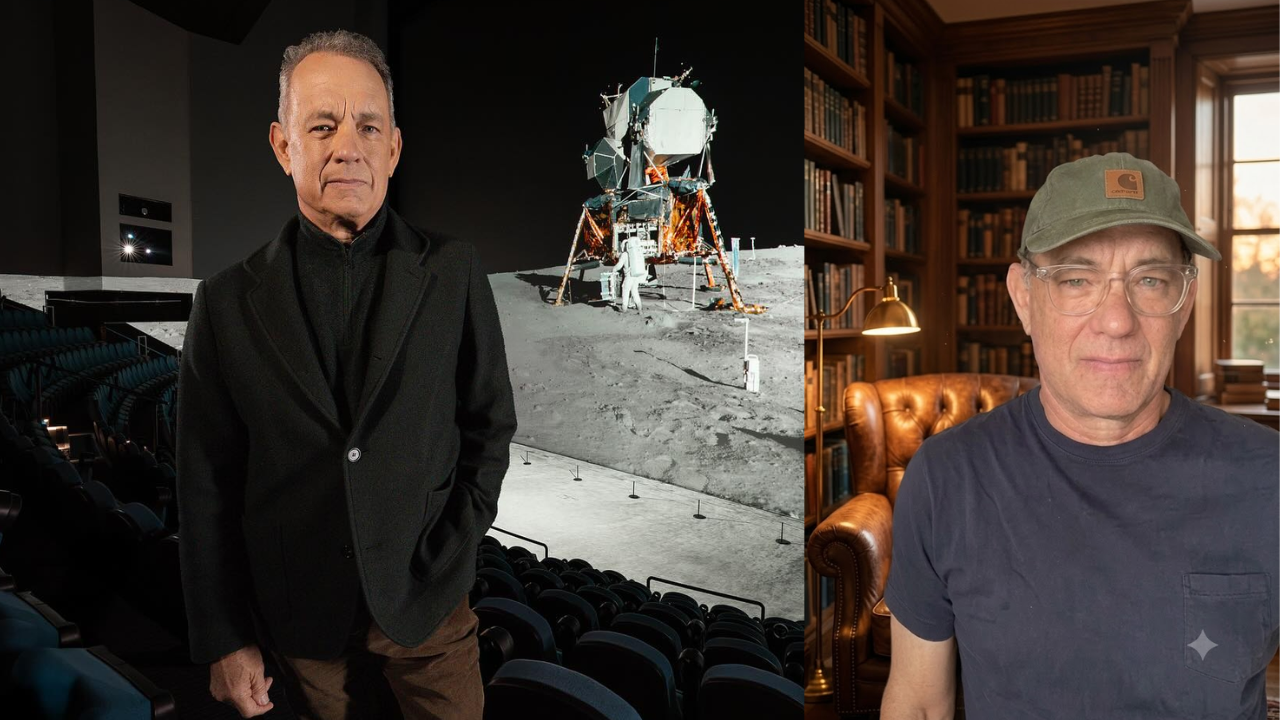
Tom Hanks has built a career that spans film, television, theatre, production, directing, and narration. Official records document two consecutive Best Actor Academy Awards, seven Emmy wins from 18 nominations as of July 2026, the AFI Life Achievement Award, the Presidential Medal of Freedom, and the Cecil B. DeMille Award.
His public record also includes long-term advocacy for military and veteran caregivers, direct statements about family support, and recent work in theatre, television narration, and Toy Story 5. Interviews offer additional insight into how he approaches acting, collaboration, childhood change, civic responsibility, and the pressures that come with a public career.
Foundations of His Acting Career
Born in Concord, California, on July 9, 1956, he is named Thomas Jeffrey Hanks. He turned 70 in July 2026.
His formal education included two years at Chabot Community College in Hayward, California, followed by two semesters at California State University, Sacramento. Hanks described this educational path himself during his 2023 Harvard commencement address. The available record confirms attendance but does not establish that he completed a bachelor’s degree.
Harvard later awarded him an honorary degree in 2023. That recognition should be distinguished from an earned undergraduate qualification.
Hanks has said that his first professional acting job came at approximately age 20 with the Great Lakes Shakespeare Festival. Looking back on that period, he described the basic demands of acting in practical terms: prepare the lines, begin the story properly, and carry it through to the end.
That simple framework remained part of his professional outlook decades later. Rather than describing acting as a mysterious process, he has emphasized preparation, narrative responsibility, and the completion of the work in front of an audience or a camera.
Breakthrough in Film
Official professional records identify Splash (1984) and Big (1988) as important early films in Tom Hanks’s career. His performance in Big brought his first Academy Award nomination for Best Actor at the 1989 ceremony.
The available research supports the description of these films as important career milestones, although terms such as “breakthrough” remain institutional assessments rather than precise measurements.
Major Career Achievements
Tom Hanks won his first Academy Award for Best Actor for Philadelphia at the ceremony held on March 21, 1994. One year later, he won the same category for Forrest Gump on March 27, 1995.
The Academy records that these victories made him the first performer since Spencer Tracy to win consecutive Best Actor Oscars. The achievement remains one of the clearest formally documented milestones in his film career.
His work has also extended well beyond feature-film acting. The Television Academy credits him as a producer, director, narrator, and performer across projects including From the Earth to the Moon, Band of Brothers, John Adams, The Pacific, Game Change, and Olive Kitteridge.
As of July 2026, the Television Academy listed Hanks with 18 Emmy nominations and seven wins. Those totals may change in later award cycles, but they demonstrate the scale of his television work through the date covered by the research.
The American Film Institute selected him for its 30th Life Achievement Award in 2002. In 2016, President Barack Obama presented him with the Presidential Medal of Freedom, the highest civilian honor in the United States.
The Golden Globes honored Hanks with the Cecil B. DeMille Award in 2020. DeMille Award on January 5, 2020. The award recognized his long contribution to film, including work both in front of and behind the camera.
His Approach to Acting and Filmmaking
In a 2023 interview with The New Yorker, Hanks described filmmaking as an uncertain and highly collaborative process. He explained that filmmakers cannot be certain during production whether the completed movie will succeed.
His comments placed trust at the center of the work. Actors and filmmakers must depend on collaborators, follow the process, and continue even when the final reception is unpredictable.
Hanks also outlined several different stages through which a project may be judged. A decision begins with agreeing to make the film, followed by seeing the completed version. Critical response, commercial performance, and the project’s reputation years later may each produce a different judgment.
That view avoids treating a film’s opening reaction as its only meaningful measure. A project may be received differently by critics, audiences, the marketplace, and later generations.
He has also said that difficult creative work can prevent complacency. Challenging material may require an artist to stretch beyond familiar habits rather than rely on earlier success.
Publicity creates another professional challenge. Hanks observed that actors have limited control over their public personas once they regularly participate in interviews and film promotion. Past roles, press appearances, and audience expectations can shape how later work is understood.
His comments addressed the mechanics of celebrity and publicity. They should not be turned into an unsupported claim that he is personally secretive or completely unwilling to discuss his private life.
Childhood Experiences and Personal Growth
In a 2024 appearance on Jay Shetty’s On Purpose, Hanks spoke about moving often throughout an unusual childhood. He described repeatedly entering new environments and learning how to adapt to changing circumstances.
He connected time spent alone with imagination and self-reliance, while frequent changes taught him to adapt and let go of familiar surroundings.
These comments came directly from Hanks and provide useful context for his understanding of adaptability and personal growth. They do not support medical or psychological conclusions about his childhood.
No diagnosis, claim of trauma, or judgment about family dysfunction should be drawn from the interview. The reliable point is narrower: Hanks has said that change and solitude influenced how he learned to adjust and imagine.
Family Values and Public Gratitude
Hanks has been married to actor and producer Rita Wilson since April 30, 1988. He publicly marked their 36th anniversary in 2024.
Reputable reporting identifies Hanks and Wilson as part of a blended family with four adult children. The verified research supports that basic family structure but does not provide grounds for describing private relationships, conflicts, or levels of closeness.
His clearest public comments about family values came during the 2020 Golden Globes ceremony. While accepting the Cecil B. DeMille Award, Hanks thanked Wilson and members of his family for their support and patience.
He acknowledged that his career had required professional absences and that his family had lived with the demands his work imposed. The speech offered a direct statement of gratitude rather than a complete account of his marriage or parenting.
It is therefore accurate to say that Hanks has publicly recognized the sacrifices and support connected with his career. It would not be responsible to use the speech as proof of a perfect family life or to make claims about private family dynamics.
Civic Beliefs and Public Responsibility
Hanks addressed civic responsibility directly during his Harvard commencement speech on May 25, 2023. His remarks emphasized truth, justice, equal rights, lawful participation, and respect for the shared humanity of others.
He also spoke about voting and presented civic responsibility as a daily practice involving participation, decency, compassion, and respect for others.
These statements provide direct evidence of the values he chose to express publicly. They should not be expanded into assumptions about every political issue, party position, or private belief he may hold.
The speech also does not establish his complete religious outlook. Moral or civic language alone is not enough to establish a denomination, a level of observance, or a detailed theological position.
Advocacy for Military and Veteran Caregivers
Hanks has held a sustained public role with the Elizabeth Dole Foundation’s Hidden Heroes campaign, which supports military and veteran caregivers.
He participated as campaign chair when the initiative launched on September 27, 2016. The foundation’s official announcement included a direct statement from him and identified his leadership role.
The campaign focuses on people who provide care for wounded, ill, or injured service members and veterans. Hanks has used his public profile to help bring attention to their responsibilities and the support they may need.
His involvement continued well beyond the launch. The Elizabeth Dole Foundation still identified him as Hidden Heroes Campaign Chair at its Heroes & History Makers event on December 1, 2025.
The available records confirm public leadership and participation. They do not provide a complete record of private donations, personal financial contributions, fundraising totals, or the number of hours he has devoted to the work.
Recent Stage, Television, and Film Work
Hanks remained professionally active through 2025 and 2026 across theatre, narration, and film.
In late 2025, he starred with Kelli O’Hara in This World of Tomorrow at The Shed in New York. The production ran from October 30 through December 21, 2025, and was directed by Kenny Leon.
James Glossman and Hanks worked together as co-writers of the play. The project added recent stage acting and playwriting to a career already associated with screen performance and production.
His television narration also received current recognition. The Television Academy nominated him in 2025 for Outstanding Narrator for the “Andes” episode of The Americas. The record identifies him as a nominee, not as the category winner.
In 2026, Hanks returned as Woody in Disney and Pixar’s Toy Story 5, released on June 19, 2026. The film continued a role closely associated with his voice work.
While promoting the film in a June 2026 interview with The Guardian, he discussed the pressure technology can place on human attention. He also spoke about the way the Toy Story films introduce younger audiences to difficult subjects such as loss and grief.
Hanks said he is not naturally good at asking for help and connected the film’s story with the idea that people are not alone. His comments framed shared responsibility and support as part of the film’s emotional meaning.
Those observations came from a promotional interview and represent his personal interpretation. They should not be presented as scientific conclusions about technology, children, or emotional development.
Conclusion
Tom Hanks’s verified public record covers much more than film acting. His career includes major work in television, narration, production, directing, and theatre, alongside two consecutive Best Actor Academy Awards and several significant institutional honors.
Direct interviews provide a clearer picture of his professional thinking. He has spoken about preparation, uncertainty, collaboration, adapting to change, managing a public persona, and continuing to seek demanding creative work.
His comments about Rita Wilson and his family center on gratitude for their support, while his public speeches emphasize civic participation, equal rights, truth, compassion, and responsibility. His long-term role with the Hidden Heroes campaign adds sustained advocacy to that record.
Recent stage work, a 2025 Emmy nomination, and his return as Woody in Toy Story 5 demonstrate that his professional activity continued as he reached age 70 in July 2026.
Fact-checking note: This profile was prepared from the verified sources reviewed during the research process. Unsupported and unconfirmed claims were excluded.