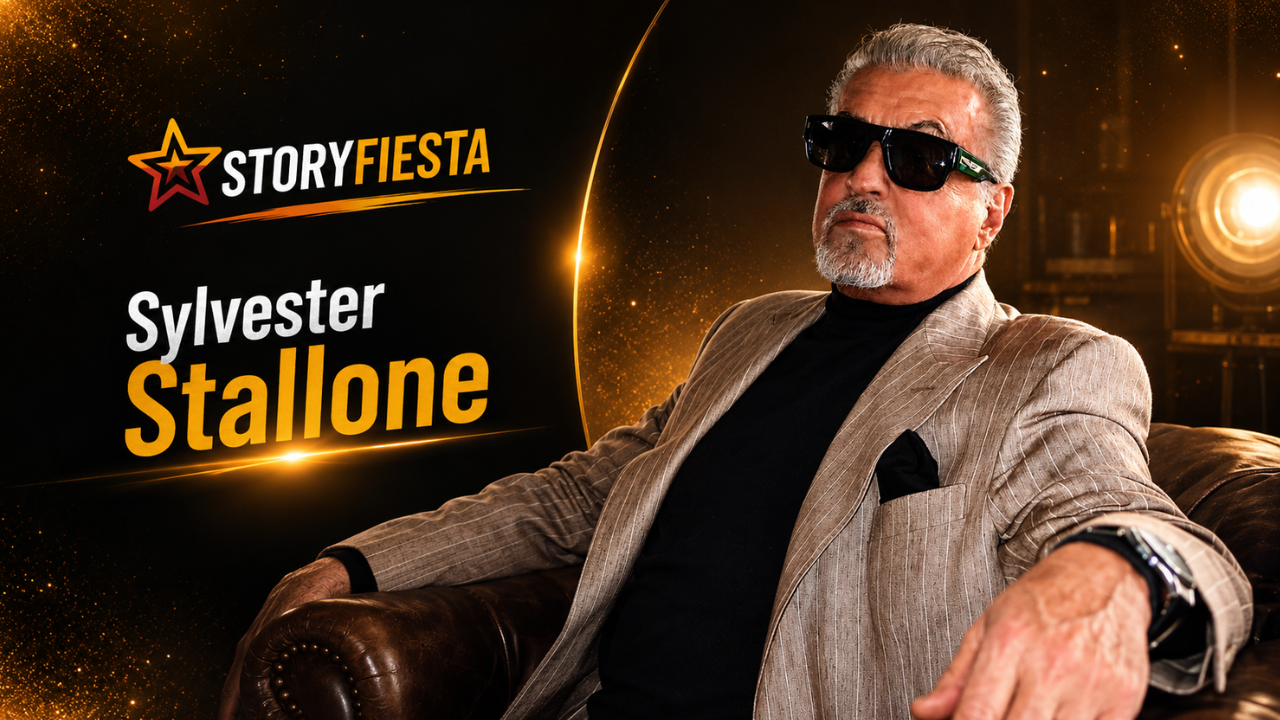
Sylvester Stallone did not begin his career with the kind of advantages usually associated with a major screen figure. A birth-related facial injury affected his speech and appearance, while bullying and a difficult home environment shaped much of his childhood. When casting opportunities later proved limited, he responded by learning to write roles for himself.
That decision led to Rocky, but Stallone’s verified history extends beyond one breakthrough. His work includes screenwriting, television production, painting, public advocacy, and decades of institutional recognition. In direct interviews, he has also spoken openly about rejection, regret, family priorities, aging, and the personal experiences behind some of his best-known writing.
Rejection Shaped His Early Direction
Born in New York City, Sylvester Stallone entered the world on July 6, 1946. He has said that an injury during his delivery caused facial nerve damage that permanently affected parts of his face, speech, and expression. Those differences became a source of bullying when he was young.
Stallone has also described an emotionally and physically difficult childhood. His accounts are personal recollections rather than independently documented legal findings, but he has consistently connected those experiences with the outsider characters he later created.
During adolescence, art became an important outlet. Stallone recalled that while attending Devereux, he began directing disruptive energy into drawing and painting. Visual art allowed him to express ideas and emotions that were difficult to communicate in other ways.
His appearance and distinctive speech later created problems in conventional casting. According to Stallone, he was often considered for limited tough-guy parts rather than the more complicated roles he wanted. Instead of waiting for the industry to offer different opportunities, he began teaching himself screenwriting.
Writing gave him control over the kinds of characters he could play. He could create men who appeared physically strong but also carried fear, uncertainty, vulnerability, or emotional conflict. That approach became central to the project that transformed his career.
Creating Rocky on His Own Terms
Stallone developed the basic structure of Rocky during 1975. The familiar claim that the completed screenplay was written in three days leaves out an important part of the process. Stallone has explained that he formed the initial spine of the story quickly but continued rewriting and reshaping it afterward.
Personal feedback also influenced the central character. Stallone credited his first wife, Sasha Czack, with pointing out that Rocky needed to become more sympathetic. That criticism helped him move the character away from a harsher early version and toward the vulnerable figure audiences eventually saw.
The screenplay attracted professional interest, but Stallone considered playing Rocky essential. He resisted stepping away from the leading role, even though accepting a screenplay-only arrangement could have provided greater immediate financial security. For him, the character was not simply material to sell. It was the role he had written because normal casting channels were not providing such an opportunity.
Released in 1976, Rocky was built around boxing but was not conceived by Stallone as only a sports story. He has repeatedly described it as a love story and a drama about an ordinary person trying to gain dignity and self-respect. Rocky’s goal was not limited to winning a fight. The emotional focus was his need to prove that his life had value.
That emphasis helped the character stand apart from a conventional undefeated hero. Rocky was uncertain, socially awkward, and accustomed to disappointment. His struggle drew on themes Stallone understood personally, including rejection, limited expectations, and the desire to create a single meaningful chance.
Recognition After the Breakthrough
Rocky received major recognition at the 49th Academy Awards on March 28, 1977. Stallone was nominated for Actor in a Leading Role and for the original screenplay. According to the Academy, he became only the third person in Oscar history to receive acting and screenwriting nominations in the same year.
The film won Best Picture, Best Director, and Best Film Editing. Stallone did not win the acting or screenplay categories, and the Best Picture award was formally credited to the film’s producers. He is therefore accurately described as the writer and star of the Best Picture-winning film rather than as a personal winner of that Oscar.
Decades later, Creed returned him to major awards consideration. His supporting performance earned another Academy Award nomination during the 2016 awards season. On January 10, 2016, he won his first Golden Globe for the role.
The later recognition connected two distant periods of his career. His first Academy nominations came from creating and portraying Rocky, while Creed brought renewed attention to the same character nearly four decades later. The achievement did not depend on repeating Rocky exactly as he appeared in 1976. The older version carried different concerns, including memory, responsibility, and the passage of time.
Personal Experience in His Later Writing
Stallone has acknowledged that parts of his later writing drew directly from regret. In Rocky V, dialogue between Rocky and his son reflected feelings about Stallone’s relationship with his own son, Sage. He said the scene functioned partly as an apology for not being present enough.
Sage Stallone died in 2012. When discussing him years later, Stallone said he still carried regret over lost time. He connected some of that absence with career demands and with the effects of his own upbringing. His comments offer a personal explanation for the emotional weight of the father-and-son material without defining every aspect of their private relationship.
Aging also changed the subjects he wanted to explore. Stallone has described Rocky Balboa as a story about grief, survivor’s guilt, and the increasing losses that accompany later life. Boxing remained part of the plot, but the deeper motivation involved a man trying to live with memories and unresolved pain.
Writing was not his only way of processing those feelings. Stallone has said that painting helps him confront regret because the past cannot be physically recovered. Both practices allow him to transform difficult experiences into something visible and structured.
He has also spoken about prayer and the emotional effects of childhood that success did not erase. His statement confirms a personal practice of prayer, though it does not establish a complete religious identity or denomination. When discussing the legacy he wants, Stallone has said he hopes to represent an average person overcoming severe odds.
Work Habits and Changing Priorities
Stallone remained deeply involved in the first two seasons of Tulsa King. He said his working day sometimes began around 3:30 or 4 a.m., when he would review and rewrite pages before production continued.
That routine belonged to a particular period rather than a permanent daily schedule. It demonstrates how closely he was involved in the series as both the lead actor and the executive producer. His contribution extended beyond performing the material placed in front of him.
Later, Stallone said he began delegating more creative responsibility. The decision was partly connected with a desire to reduce his need for control and protect more time for his family. It marked a change from the intense self-reliance that had shaped much of his earlier career.
His professional habits began with the belief that he had to create and protect every opportunity himself. At a later stage, he described learning to trust other people with more of the daily work. The change did not mean stepping away from production, but it allowed him to reconsider how much personal time each project should consume.
Work Beyond Acting and Screenwriting
Stallone’s influence on boxing culture received official recognition in 2011, when he was inducted into the International Boxing Hall of Fame. He was inducted in the observer category for the impact of Rocky Balboa, not for competing as a professional boxer. In his acceptance remarks, Stallone acknowledged that he did not possess the skills of a professional boxer.
His public work has also included support for amfAR. On November 22, 2024, Sylvester and Jennifer Stallone received the organization’s Award of Inspiration. amfAR linked the honor to its support for HIV/AIDS research and other causes related to health, education, and women’s rights. Stallone publicly expressed confidence in the possibility of defeating HIV/AIDS.
Another institutional honor followed in 2025. Stallone was selected as part of the 48th Kennedy Center Honors class and received his honoree medal at the U.S. Department of State on December 6, 2025.
Painting has remained a separate creative practice throughout his life. Stallone has said it began before his acting career and became a way to process emotion. Sylvester Stallone: Evolution, presented at Art Palm Beach from January 28 to February 1, 2026, brought together works from different stages of his development, including pieces from the 1960s.
His Current Chapter at 80
Stallone turned 80 on July 6, 2026, while remaining involved in several confirmed projects. Paramount+ had already renewed Tulsa King for a fourth season on September 17, 2025. The renewal kept him involved in the series as both its leading performer and an executive producer.
CBS News reported in December 2025 that he was filming the season, and later, in July 2026, continued to identify the series as an active part of his schedule. No official premiere date for the fourth season was confirmed in the reviewed material.
His television work also extends to Frisco King, a related series led by Samuel L. Jackson. Paramount+ identifies Stallone as an executive producer. The project, previously known as NOLA King, remained in development as of February 2026, with no announced release date.
Stallone is also preparing to publish The Steps. HarperCollins currently schedules the memoir for September 29, 2026, after an earlier announced date of May 5. The publisher describes the book as covering his difficult early years, his move to New York, the creation of Rocky, and the events leading to the 1977 Academy Awards.
Lesser-Known Confirmed Facts
Before his major screen success, Stallone spent two years at the American College of Switzerland and later studied drama at the University of Miami. The university identifies him as a B.F.A. ’98 alumnus, although his original period of study began decades earlier and did not continue uninterrupted until 1998.
In 2015, the University of Miami presented him with the Edward T. Foote II Alumnus of Distinction Award. That recognition forms part of his documented connection with formal arts education, even though his professional development depended heavily on self-directed writing and performance.
His painting career also began much earlier than many readers may realize. Stallone was making art during adolescence and continued the practice alongside acting and screenwriting. The 2026 Art Palm Beach retrospective did not introduce a new interest; it presented decades of work from a creative activity that had long existed beside his public screen career.
Conclusion
Sylvester Stallone responded to early rejection by creating opportunities that conventional casting had not provided. Writing gave him the chance to develop Rocky, claim the starring role, and create a hero defined by both emotion and strength.
His later work expanded those themes through grief, aging, regret, and family responsibility. At the same time, he continued working in television, executive production, visual art, advocacy, and publishing. By the time he turned 80 in July 2026, his current projects still carried the self-directed approach that began when rejection pushed him to write for himself.
Fact-checking note: This profile was prepared from the verified sources reviewed during the research process. Unsupported and unconfirmed claims were excluded.
Frequently Asked Questions
Did Sylvester Stallone write the complete Rocky screenplay in three days?
No. Stallone has said that he developed the basic structure of Rocky in about three days, but he continued to revise and reshape the screenplay afterward.
Did Sylvester Stallone personally win an Oscar for Rocky?
No. He received Academy Award nominations for acting and original screenplay, while Rocky won Best Picture. That award was credited to the film’s producers.
What led to Sylvester Stallone being inducted into the International Boxing Hall of Fame?
He was inducted in the observer category in 2011 for the cultural impact of Rocky Balboa on boxing. The honor did not recognize him as a professional boxer.
What is the current release date for Stallone’s memoir The Steps?
HarperCollins currently lists The Steps for publication on September 29, 2026. An earlier May 5, 2026 date was later changed.