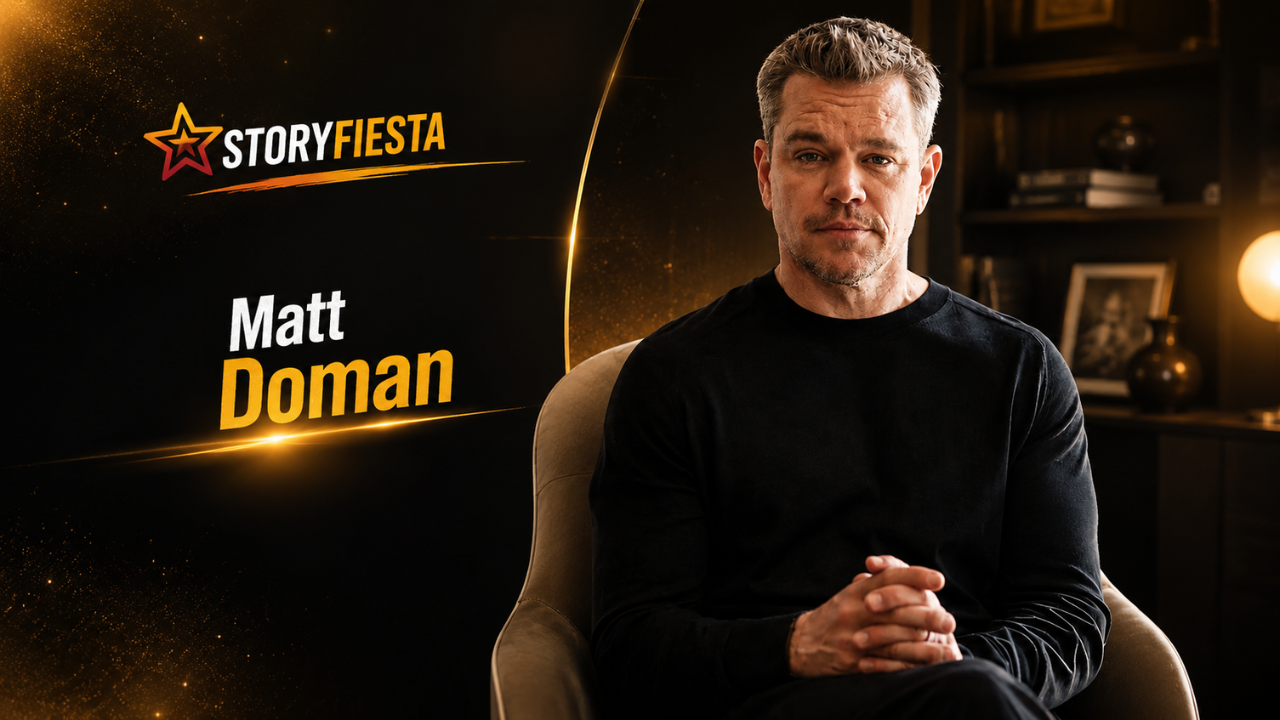
Matt Damon has entered a more deliberate stage of his professional life. Rather than maintaining a constantly full acting schedule, he said in 2026 that he had slowed his workload, spent more time reading, and become increasingly selective about the roles he accepts.
A central part of that change is Artists Equity, the artist-led studio he launched with Ben Affleck in 2022. Damon serves as the company’s Chief Content Officer, giving him responsibilities that extend beyond performing. His current work combines selected acting roles, production strategy, family responsibilities, and long-term public advocacy.
A More Selective Approach to Work
In a 2026 GQ interview, Damon said he was accepting fewer acting assignments and devoting more attention to producing through Artists Equity. He connected that shift with a reduced need to prove himself and a desire to protect time for his family.
The change does not amount to retirement. Damon remained active in major productions during 2026, but his comments suggest that he was evaluating opportunities more carefully. Acting became one part of his broader professional role, alongside reviewing scripts, developing projects, and guiding Artists Equity productions.
That approach fits with views he expressed earlier in his career. In a 2019 interview, Damon said he measures success largely through the quality of the work and the process behind it. Audience response and commercial results cannot always be controlled, so he focuses on whether he gave the work his full effort and helped tell the intended story.
His growing selectiveness signals a shift in professional priorities rather than a move away from his work. Damon is still performing, but he is also deciding where to use his time and experience most effectively.
Building Artists Equity with Ben Affleck
In 2022, Damon partnered with Ben Affleck to establish Artists Equity. The company identifies Damon as a co-founder and its Chief Content Officer, with responsibilities connected to creative direction and overall strategy.
Artists Equity describes itself as an artist-led studio, while Damon’s official role includes helping shape its creative direction and overall strategy. His position includes helping shape the company’s creative direction and overall strategy.
Artists Equity also continues a professional partnership that began long before the company existed. Damon and Affleck won the Academy Award for original screenplay for Good Will Hunting at the 70th Academy Awards on March 23, 1998. Damon also received a nomination for Actor in a Leading Role at the same ceremony.
Their later work through Artists Equity places that earlier writing partnership in a broader business setting. Damon is no longer involved only as a performer or screenwriter. He now holds an official leadership role within a company responsible for developing and producing new work.
Connecting Producing and Acting
Damon’s work on The Rip illustrates how his acting and producing responsibilities can overlap. Netflix released the project on January 16, 2026, identifying Damon as a leading cast member and Artists Equity as the production company.
The project placed him in front of the camera while also connecting the production to the studio he helped establish. That combination is important to understanding his current professional direction. Damon has not abandoned acting in favor of management; The Rip connected his performance work to a company where he holds a leadership position.
As Chief Content Officer, Damon participates in broader creative direction and company strategy alongside his acting work.
His 2026 comments suggest that this expanded role has affected how he thinks about his schedule. Damon said that he was spending more time reading and producing through Artists Equity while becoming increasingly selective about acting assignments.
Career Decisions Guided by Commitment
Damon has repeatedly described professional decisions in terms of responsibility to the people already involved. One of his clearest examples concerns the opportunity to lead Avatar.
He said he declined the offer because accepting it would have required leaving colleagues who were already working on The Bourne Ultimatum. Damon framed the choice as an ethical obligation to an existing production rather than a simple comparison between two roles.
The decision later became associated with reports about the large amount of money he might have earned through a proposed percentage arrangement. Those figures remain hypothetical because they depend on a deal he never accepted and on the project’s later financial performance.
The more useful part of the account is Damon’s explanation of why he stayed. He believed that walking away would have placed an unfair burden on people who had already committed their time and work.
That reasoning is consistent with his process-based definition of success. Damon has said that professional outcomes cannot always be predicted, but the effort given to colleagues and to the work remains within a person’s control.
Lessons from Rejection and Difficult Productions
Damon has spoken openly about failure as part of professional development. During his 2016 MIT commencement address, he recalled repeated unsuccessful auditions early in his career and said those experiences helped him build resilience.
He also encouraged graduates to keep learning after formal education. Damon attended Harvard University but did not complete his degree after professional work interfered with his remaining coursework. His account focused less on leaving university and more on the danger of assuming that success removes the need for continued learning.
A later experience tested his professional discipline differently. Damon recalled becoming deeply discouraged during an unnamed production that was not meeting his expectations. He said his wife reminded him that the commitment had already been made.
After that conversation, he focused on completing the work with full effort and maintaining a constructive attitude during long production days. Damon used the word “depressed” conversationally while describing the experience, but he did not identify the project or describe a diagnosed medical condition.
The account offers a practical view of professionalism. For Damon, commitment did not depend on believing the final result would succeed. It meant continuing to work responsibly even when the experience had become disappointing.
Family, Privacy, and Working Habits
Family responsibilities have influenced both Damon’s public boundaries and his professional routines. In a 2007 GQ interview, he said he did not want to use his marriage or children to promote his work.
He also corrected an inaccurate public description of his wife’s occupation and explained that excessive disclosure could damage something personally important to him. His comments established a boundary around publicity without providing unnecessary details about his family.
Damon confirmed in his 2016 MIT speech that his wife and four children attended the event. In a 2012 Guardian interview, he said all four children were daughters and discussed the values he hoped to emphasize as a parent.
He wanted his children to understand their advantages and recognize that other families live under very different economic and cultural circumstances. He linked that goal to living in a diverse urban setting and to the travel he had experienced while growing up.
Family obligations have also shaped specific working routines. In a 2021 interview, Damon described collaborative writing sessions arranged around getting the children ready, working for roughly four or five hours, and returning to responsibilities at home.
That schedule related to a particular writing period rather than a permanent daily routine. More recently, his 2026 comments again connected career selectivity with time at home, suggesting that family considerations remain part of how he evaluates professional opportunities.
Water Access and Long-Term Public Work
Damon’s public work on water and sanitation has developed across two decades. Water.org states that he founded the H2O Africa Foundation in 2006 after witnessing the consequences of limited access to safe water and sanitation.
He met water specialist Gary White at the Clinton Global Initiative in 2008. Their organizations later came together to establish Water.org in 2009.
Water.org identifies Damon as a co-founder involved in the organization’s advocacy, strategy, and international engagement. In his MIT commencement speech, he connected a 2006 visit to Zambia with the direction his public work later took.
His comments about advocacy emphasized direct engagement. Damon encouraged graduates to move toward difficult problems, examine them closely, and recognize the blind spots that can remain invisible from a distance.
On June 9, 2026, Water.org launched Get Blue with Damon White and founding partners, including Gap Inc., Starbucks, Amazon, and Ecolab. The initiative was designed to connect purchases, sharing, and direct donations with support for water and sanitation programs.
Water.org reported that its programs had helped more than 90 million people gain access to safe water or sanitation. That figure comes from the organization’s own reporting, while Damon’s confirmed role is his continuing participation as a co-founder and public advocate.
Recent Demands and Changing Priorities
Damon’s selective approach has not prevented him from accepting physically and professionally demanding work. Universal Pictures scheduled The Odyssey for theatrical release on July 17, 2026, and Damon attended its London premiere on July 6.
In a Reuters interview published the following day, he described the production as the most difficult and demanding of his career. He cited practical effects, real ships, large groups of people, and severe weather as major challenges.
During a July 7 appearance on Amy Poehler’s Good Hang, Damon said preparing for the role required a complete, temporary lifestyle change. His routine involved demanding training, dietary adjustments, and limited sleep during production.
He compared the experience more closely to an expedition than an ordinary production. The account was specific to the demands of that project rather than describing his normal health or fitness habits.
The demanding production was one of the major roles Damon accepted during the period in which he said he had become more selective about his work.
Conclusion
Matt Damon’s current professional life combines carefully selected acting roles with a broader creative role at Artists Equity. Since launching the studio with Ben Affleck in 2022, he has taken on formal responsibility for creative direction and strategy while continuing to perform in projects connected with the company and other major productions.
His interview comments describe a career increasingly guided by commitment, process, and control over his time. His comments connect those decisions with family time, producing responsibilities, and a reduced need to prove himself professionally.
Damon remains active, but his priorities have changed. He now defines progress through carefully chosen work, trusted professional partnerships, and deeper participation in the development of projects.
Fact-checking note: This profile was prepared from the verified sources reviewed during the research process. Unsupported and unconfirmed claims were excluded.