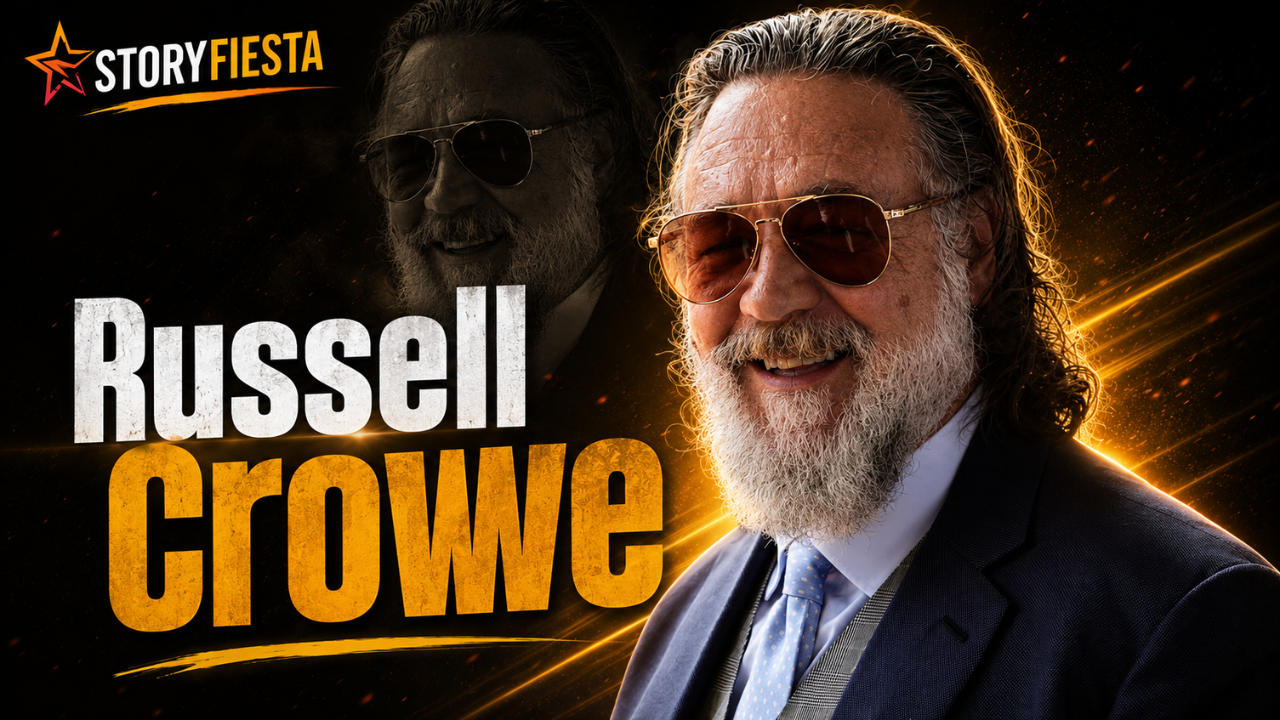
Russell Crowe is best known for major screen performances, but acting represents only one part of his professional life. His verified work also includes music, live performance, feature directing, screenwriting, leadership within the Australian film industry, rugby league ownership, and public advocacy.
Several of these interests began before his international recognition as an actor. Others developed after he had already received major awards, including the Academy Award for Gladiator and the BAFTA Leading Actor award for A Beautiful Mind. Rather than remaining within one established role, Crowe has continued moving between different forms of storytelling and public work.
Music Came Before International Film Recognition
Russell Crowe’s involvement in music did not begin after he became internationally recognized on screen. Institutional records from NZ On Screen document his early work under the performing name Russ le Roq and preserve a television appearance with Roman Antix, broadcast on 26 November 1985.
The 1985 broadcast documents an early performance, but it does not identify exactly when his musical work began. Still, it confirms that performance was already part of his working life well before his most widely known films. His later music projects therefore belong to a long-running creative interest rather than a recently adopted celebrity sideline.
Family circumstances also shaped Crowe’s early professional direction. In a 2024 interview, he said he had expected to study history but left school after his father lost his job. Earning money and helping his family became the immediate priority. His path into entertainment was not the result of a single, carefully planned decision; it grew from practical responsibilities alongside his existing interest in performance.
Building Indoor Garden Party
Crowe’s current music work includes Indoor Garden Party, a collaborative concept that began in 2009. Its official description combines music, storytelling, and live performance, with different musicians and contributors joining at different times.
That changing structure is central to the project. Indoor Garden Party is not presented as a conventional band with one permanent lineup. Instead, it operates as a flexible performance format that allows Crowe and his collaborators to combine songs with conversation and stories.
The project remained active in 2026 by promoting a new recording and video of “The Beast in Me.” Nick Lowe wrote the song, so Crowe’s version is an interpretation rather than an original composition. Its release nevertheless provided current confirmation that music remained part of his professional schedule.
Indoor Garden Party also connects several parts of Crowe’s creative life. It gives him a setting for live music, collaboration, personal storytelling, and direct contact with audiences, without adhering to the fixed processes of film production.
Why Live Performance Still Matters to Him
Crowe has explained that live performance gives him something different from acting. Film production is highly organized, with schedules, technical demands, and many collaborators whose needs must be coordinated. A concert remains less predictable because the audience can influence the mood and direction of the evening.
He has described that uncertainty as a mental reset. Even when the songs and performers are familiar, each audience creates a different experience. That immediate exchange is difficult to reproduce on a film set, where scenes may be repeated, edited, and assembled long after the original performance.
Music has also served a personal purpose in his life. Crowe said he wrote “Stronger Than Stone” as advice for his two sons, imagining the song might continue to communicate with them even after he was no longer present. Crowe described the song as advice for his sons and said he hoped it would continue to communicate with them after his death.
He has also discussed using songs to express thoughts during difficult periods. Crowe said much of the material on his 2011 album with Alan Doyle was written as he tried to communicate during the breakdown of his marriage. He described his own purpose in writing those songs without assigning responsibility to anyone else.
Moving from Acting into Directing and Writing
Crowe expanded his screen work by directing the 2014 feature film The Water Diviner. He also played the leading role. Institutional profiles identify it as his feature-film directing debut.
Directing The Water Diviner moved Crowe beyond acting into responsibility for the complete production of a feature while he continued to perform in the leading role. The move also matched an outlook he later expressed in interviews: he remains more interested in unfamiliar creative territory than in repeating roles or character types that have already worked for him.
His work on the 2026 Australian sports drama Beast added screenwriting to that broader record. Official information confirmed Crowe as a performer in the production, while reputable reporting identified him as a co-writer. He played the coach of the central mixed-martial-arts fighter.
Crowe has also said he once declined a film about a musician he admired because he worried that accepting the part might give him a level of musical credibility he had not earned. He did not identify the musician, director, or production. Because Crowe did not identify the project, the musician, director, and production remain unknown.
Supporting Australian Film and Television
In November 2020, the Australian Academy of Cinema and Television Arts appointed Russell Crowe as its President. The role placed him within the institutional side of Australia’s screen industry as well as its creative workforce.
Crowe used the appointment to express support for Australian productions and talent. His involvement with AACTA is separate from winning or receiving awards; it is a leadership position connected with the organization’s broader work in film and television.
His comments about acting also help explain why this type of role fits his professional outlook. During a Screen Actors Guild acceptance speech in 2002, he described actors as storytellers whose work can release emotions, begin conversations, and offer audiences experiences they may not find elsewhere.
More than two decades later, while accepting the Zurich Film Festival’s Golden Eye Award for Lifetime Achievement on 27 September 2025, Crowe again placed audiences near the center of his work. He said he wanted films to affect emotions, open minds, and foster recognition of shared humanity. These statements describe his artistic aims rather than guaranteeing how every viewer will respond.
A Longstanding Role in Australian Rugby League
Crowe’s public work also extends into professional sport through the South Sydney Rabbitohs. Official club records continue to identify him as a co-owner, with his interests held through Blackcourt League Investments.
A 2021 ownership transaction left Crowe holding one-third of that investment structure. The arrangement makes Crowe a co-owner rather than the club’s sole owner, and the official records do not give him complete control over its daily operations.
His connection with the Rabbitohs is therefore more substantial than that of a well-known supporter attending matches. It represents ongoing ownership involvement in Australian rugby league, maintained alongside his film and music work.
Public Advocacy and National Recognition
Crowe has occasionally used public appearances to address issues beyond entertainment. During the Australian fire crisis, he prepared a written message that was delivered at the Golden Globes on 5 January 2020 while he remained in Australia.
In that statement, he linked the fire crisis to climate change and called for action grounded in scientific evidence, renewable energy, and greater respect for the environment. The message confirms the position he expressed at that event. It does not establish every aspect of his personal environmental practices or automatically connect him to any particular organization.
Another form of public recognition came on 27 February 2026, when Crowe was appointed an honorary Commander in the Royal Australian Navy during a ceremony aboard HMAS Sydney V. Defense-linked institutional records connected the honor with his advocacy for the Navy, his public storytelling, and his support for the Defense community.
The appointment was honorary. It did not represent conventional naval enlistment, officer training, or operational command. Its significance lies in the formal recognition of his public support and relationship with Australia’s naval community.
The Values Behind His Creative Decisions
Crowe’s own interviews provide a clearer picture of how he approaches work than broad personality labels can. He has said that he spent roughly 35 years following creative interests rather than organizing decisions around other people’s approval. He has also spoken about preferring unfamiliar work to repeating established character types.
Family also appears in his songwriting. Crowe described “Stronger Than Stone” as advice intended for his sons and said he hoped it would continue to communicate with them after his death.
Crowe has also spoken directly about regret. He rejected the claim that he has none, mentioning angry words, overreactions, and missed opportunities for friendship. He described reflection as a way to recognize behavior he did not want to repeat. His comments were general and did not claim that every past conflict had been resolved.
His account of life away from work is quieter. In 2024, he described a rural routine involving open space and farm animals. That description supports a contrast between his public schedule and his off-duty environment, but it does not justify portraying him as isolated or withdrawn.
When discussing his father’s death in 2021, Crowe recalled a striking gathering of black cockatoos and said he did not know what the afterlife contained. He presented the experience as personally meaningful while leaving its explanation uncertain. The account does not establish a formal religious belief or a supernatural conclusion.
Russell Crowe’s Work Beyond the Screen
Russell Crowe’s work beyond acting is best understood as a connected creative practice rather than a collection of unrelated side projects. Music was part of his working life before international film recognition, and his later involvement in directing, writing, industry leadership, sport, advocacy, and public service broadened the ways he participates in storytelling and Australian public life.
His own comments place audience connection, family responsibility, reflection, and interest in unfamiliar creative ground at the center of those decisions. The result is a professional record that reaches beyond screen performance while remaining closely tied to communication and collaboration.
Fact-checking note: This profile draws exclusively from reliable sources examined and confirmed during the research stage. Unsupported and unconfirmed claims were excluded.