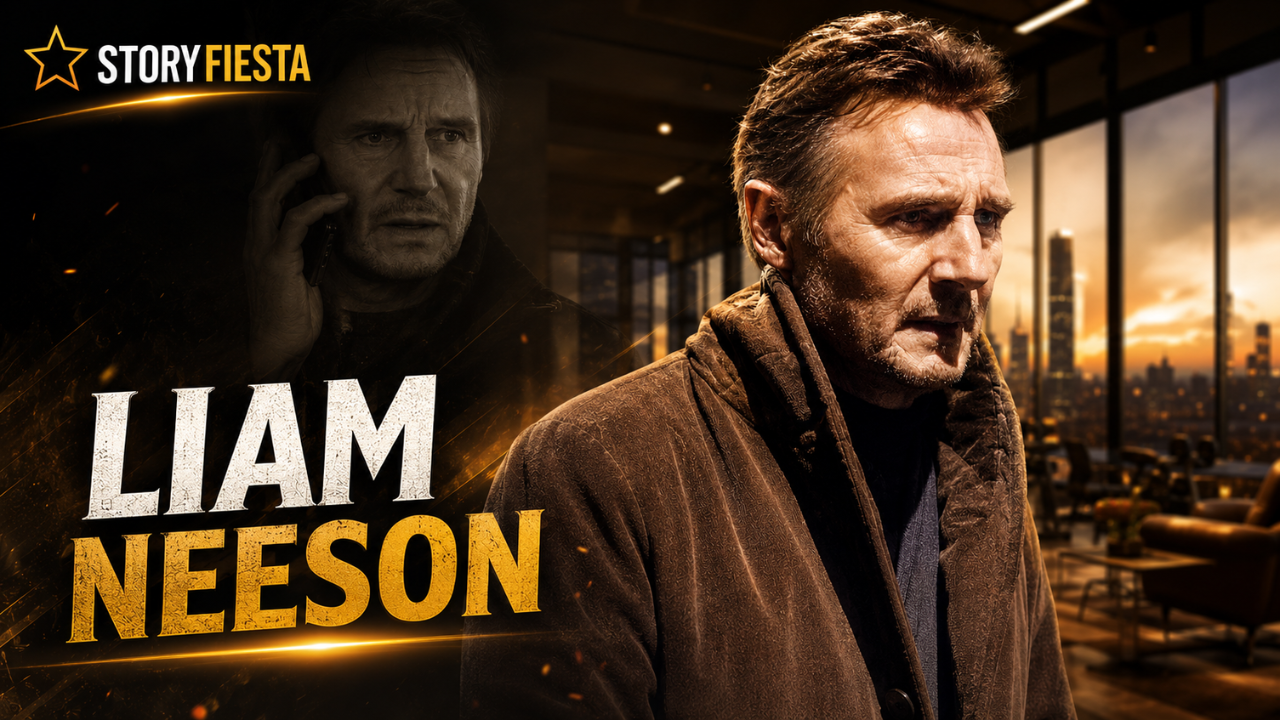
Liam Neeson began his professional career on a Belfast stage in the 1970s. He later became internationally recognized through major screen performances, physically demanding roles, and long-running public work with UNICEF. His verified record includes an Academy Award nomination, an OBE, an honorary degree from a university, and formal recognition from the Irish Film & Television Academy.
His public story also includes difficult personal experiences that he has discussed directly, including bereavement, fatherhood after loss, memories of violence in Northern Ireland, and a controversial admission about a past desire for revenge. Alongside his acting work, Neeson has supported children affected by conflict, poverty, discrimination, and reduced humanitarian assistance.
From Ballymena to the Belfast Stage
Liam Neeson was born in Ballymena, County Antrim, Northern Ireland, in 1952. Reputable reporting gives his full birth date as 7 June 1952, although the strongest institutional profiles reviewed confirm only the year.
He began his professional stage career in Belfast in 1976. That starting point is important to understanding the scale of his later career. His early professional foundation came from Northern Irish theatre, years before international productions and action roles defined his screen career.
Neeson has also spoken directly about growing up during the Northern Ireland conflict. In a 2022 interview, he said memories of violence remained with him into adulthood. He cautiously considered whether those experiences may have affected his character, but he did not disclose any formal psychological diagnosis.
He said that violence was part of the environment he remembered from childhood and that those memories remained significant many years later.
International Recognition and Career Milestones
One of Neeson’s most important career achievements came through his performance as Oskar Schindler in Schindler’s List. His portrayal of Oskar Schindler earned him a Best Actor nomination at the 1994 Academy Awards. It was an Oscar nomination rather than a win.
His work later received recognition from several official institutions. Neeson was appointed an Officer of the Order of the British Empire, with the appointment recorded on 31 December 1999 as part of the 2000 New Year Honors. The distinction is an OBE, not a knighthood.
In 2009, Queen’s University Belfast awarded him an honorary Doctor of the University degree. The qualification was honorary and should not be confused with an earned academic doctorate.
The Irish Film & Television Academy gave Neeson its Outstanding Contribution to Cinema award in April 2016. At the time, IFTA stated that he had appeared in 84 films. Neeson later said that he completed what he considered his 100th film in December 2021.
Those totals are not necessarily in conflict. Film counts can change depending on whether databases include television films, voice performances, shorts, cameos, completed productions, or projects that had not yet been released.
How Taken Changed His Professional Direction
Neeson did not describe Taken as part of a carefully planned attempt to reinvent himself. In interviews, he said he accepted the project partly because he wanted to do something physically demanding.
He also admitted that he had not expected the production to alter the direction of his career. His belief that it might receive limited distribution was his personal expectation, not a documented release strategy. The film was followed by a sustained period of action-oriented roles later in his career.
That shift happened later in his professional life, after he had already built a long stage and screen career. Neeson viewed the career shift as an unforeseen result of a single project, not a direction he had deliberately pursued.
He later suggested on more than one occasion that his period as an action lead might be approaching its end. Those comments were tentative rather than formal retirement announcements. His later projects, including action work scheduled for 2026, showed that he remained willing to take on physically demanding roles.
Work Habits and His Approach to Aging
Neeson has been clear about the difference between staged fight work and dangerous stunt performance. He said that he participates in choreographed fight scenes but leaves genuinely hazardous stunts to trained professionals.
To prepare for demanding productions, he has said he tries to stay reasonably fit. In interviews, he mentioned walking and exercising at home, though those comments did not establish a fixed training program or permanent daily routine.
Reading has also appeared in his descriptions of life away from production. He referred to it as part of his nighttime routine, while fly-fishing was presented as an activity that requires patience and concentration.
As he grew older, Neeson spoke with some surprise about continuing to receive substantial scripts. He expressed gratitude that professional opportunities were still coming his way and said he intended to work as long as he remained interested and physically able.
His comments about aging were practical rather than absolute. He did not set a firm retirement date, and his career decisions kept changing depending on the projects offered to him.
Fatherhood, Loss, and Personal Responsibility
Neeson was married to Natasha Richardson, who died in March 2009 following a skiing accident. He later discussed the loss in a 2014 60 Minutes interview, speaking directly about grief, the medical decisions made by the family, and organ donation.
In the 2014 interview, he described grief as unpredictable and said it could return suddenly and without warning.
Neeson raised two sons with Richardson, Micheál and Daniel. In interviews, he described fatherhood as a central responsibility and spoke about trying to provide stability after their mother’s death.
He also said that teaching manners and respect mattered to him while raising his sons.
A Public Admission Requiring Careful Context
In February 2019, Neeson disclosed a disturbing episode from many years earlier. He said that after learning a close friend had been raped and being told that the attacker was Black, he carried a weapon while looking for an uninvolved Black man whom he might provoke and kill.
Neeson said no attack occurred. He expressed shame about what he had done and described the experience as part of his realization that revenge creates further violence.
The disclosure drew widespread criticism because the person he sought was not the alleged attacker and was targeted only because of race. In a follow-up interview, Neeson denied that he was racist and said he had sought help after the episode. He also argued that his anger would have focused on whichever group identity he had been given.
That explanation was his own account and did not independently resolve the controversy. The confirmed facts are that he admitted racially targeted violent intentions, no assault occurred, and he later expressed shame while trying to explain how he had moved away from that desire for revenge.
Becoming a UNICEF Goodwill Ambassador
Neeson’s work with UNICEF began before he received the organization’s title of global ambassador. An official UNICEF profile records that he participated in a field visit to Mozambique in 2005 and supported the organization for several years.
In 2011, he became a UNICEF Goodwill Ambassador. Through that role, he publicly committed himself to helping children affected by poverty, violence, disease, and discrimination.
His connection with UNICEF developed into sustained public work rather than a single appearance. It has included field visits, awareness campaigns, public statements, and efforts to draw attention to the conditions facing children in conflict-affected areas with limited resources.
UNICEF’s record of his work also contains one date inconsistency. Its profile summary lists a visit to Jordan in 2017, while a photograph caption dates the pictured visit to 7 November 2016. The clearest confirmed date for the photographed visit is November 2016.
Supporting Children in South Sudan
In October 2025, Neeson completed a six-day UNICEF visit to South Sudan. During the trip, he met children, parents, health workers, and young people dealing with severe humanitarian pressures.
UNICEF reported that the visit addressed malnutrition, insecurity, child marriage, abuse, and reductions in humanitarian funding. Neeson used his public role to bring attention to how these conditions affect children and the services intended to support them.
The organization’s release carries a minor date discrepancy: the webpage displays 26 October 2025, while the press-release dateline says 27 October. The difference does not affect the confirmed details of the six-day visit.
The South Sudan trip was one of the clearest recent examples of Neeson continuing to fulfill his humanitarian role well beyond his initial Goodwill Ambassador appointment.
Integrated Education and Conservation Work
Neeson has also supported public projects connected with Northern Ireland. In October 2023, he narrated an awareness campaign for the Integrated Education Fund.
He said he hoped the campaign would improve understanding of integrated education and encourage greater support for it. His public comments focused specifically on support for integrated education.
Environmental education became part of another recent narration project. Neeson was announced as the narrator of Running Wild: Return to the River, a giant-screen documentary focused on Pacific salmon and the ecosystems that depend on them.
The official announcement was dated 10 November 2025, although the hosting page later carried different posting metadata. Screenings were expected to begin in 2026, with availability depending on individual venues and territories.
Continuing Professional Projects
Neeson continued to accept professional roles into his seventies, including projects that required the physical presence associated with his later action work.
One confirmed 2026 project was The Mongoose, an action thriller in which he plays the leading role. A trailer was reported in July 2026, and the film was scheduled for a US theatrical release on 30 October 2026.
Because that date was still in the future when it was verified in July, it remained subject to a possible change in distributor. Even so, the confirmed project demonstrated that earlier suggestions to leave action work had not resulted in a permanent retirement.
His career at this stage remained active across multiple project types. Alongside action productions, his recent work included documentary narration and humanitarian advocacy through established organizations.
Conclusion: A Career Connected to Public Service
Liam Neeson began professional stage work in Belfast in 1976 before moving into a screen career recognized by the Academy, the British honors system, Queen’s University Belfast, and the Irish Film & Television Academy.
His interviews provide first-hand accounts of fatherhood, grief, aging, professional uncertainty, and lessons drawn from serious mistakes.
Beyond acting, his long association with UNICEF has included field visits, public campaigns, and recent work in South Sudan. His support for integrated education and his narration of a conservation documentary further connect his public profile with educational and humanitarian projects. From the Belfast stage to international productions and UNICEF advocacy, his verified history covers both professional longevity and sustained public service.
Fact-checking note: This profile was prepared from the verified sources reviewed during the research process. Unsupported and unconfirmed claims were excluded.