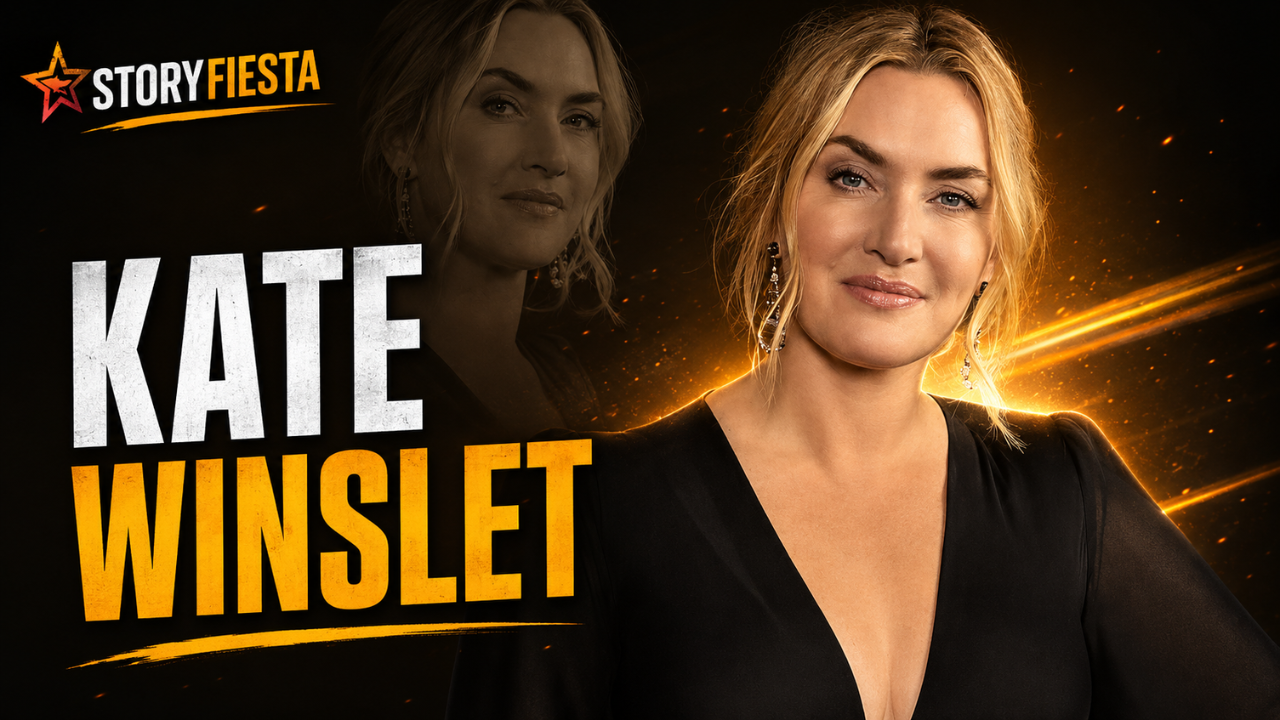
Kate Winslet has increasingly shaped her work both behind and in front of the camera. That shift became especially clear with Lee, which she produced and starred in, and Goodbye June, her first feature as a director.
The two projects allowed her to shape each story more closely, guide performances, and handle complex themes with greater control. In interviews, she has discussed the pressure that followed early fame, the importance of professional boundaries and her preference for work chosen through personal and creative judgment rather than constant visibility.
Moving Beyond the Pressure of Early Fame
The worldwide success of Titanic brought Kate Winslet a level of attention that changed both her daily life and her career. In later interviews, she described the period after the film as intrusive and difficult. Ordinary experiences became harder, while public interest in her expanded far beyond the work itself.
Rather than using that moment to pursue only the largest available productions, Winslet moved toward smaller and less predictable projects. She has explained that this was a deliberate response to the pressure surrounding her. The sudden scale of fame did not become the sole guide for what she accepted next.
Her comments do not suggest that she regretted making Titanic. Instead, they explain why her later career did not follow a simple path of choosing increasingly commercial roles. She tried to honor her instincts and continue working without letting celebrity attention dictate every decision.
That approach helped lay the foundation for the more involved creative roles she would later take on. By the time she began developing Lee and directing Goodbye June, she was not only selecting performances but also helping to shape entire productions.
Choosing Work That Creates a Real Challenge
Winslet has said that she is drawn to roles that frighten or surprise her. During BAFTA’s A Life in Pictures event in December 2015, she explained that she did not want every part to feel safe or familiar.
Her preparation varies depending on the production. Some performances require detailed research, while others benefit from flexibility and room for improvisation. She has not presented one fixed method as the answer for every character.
Another important change came through her ability to say no. In a 2024 roundtable of actresses, Winslet said it had taken her years to become comfortable with refusing opportunities. That admission placed professional boundaries alongside talent and preparation as part of her growth.
Saying no gave her more space to choose the work she genuinely wanted to support. It also became increasingly important as her responsibilities expanded beyond acting. Producing and directing required her to make decisions about the story, the working environment and the standards she wanted the production to follow.
Bringing Lee Miller’s Story to the Screen
Winslet’s involvement with Lee began with her growing interest in photographer and war correspondent Lee Miller. She later worked with Miller’s son, Antony Penrose, as she developed the project and researched the woman behind the public image.
Reliable accounts describe the development process differently. TIME referred to an effort lasting about eight years, while the Associated Press described it as nearly ten. The clearest description is that Winslet spent much of a decade trying to bring the film to the screen.
Winslet said she wanted to avoid reducing Miller to simplified labels and instead portray her as a complex photographer and war correspondent.
That long development period placed Winslet in a position far beyond that of a performer hired after the main decisions had already been made. She remained involved in the project’s development, historical focus and portrayal as both its lead actor and a producer.
Lee was released in the United States on September 27, 2024. By then, the project had become one of the clearest examples of Winslet using her influence to protect a particular interpretation of a real person’s life and work.
Taking Greater Control Behind the Camera
As a producer of Lee, Winslet had more authority over how the film represented its central figure. Her involvement extended to creative decisions that affected both the character and her own on-screen appearance.
In an interview with TIME, she said that she resisted efforts to make her body appear artificially slimmer during production. She did not view an unaltered adult body as something that should automatically be promoted as unusually brave. For her, the choice belonged to an honest portrayal rather than a publicity statement.
That position was directly connected to the way she wanted the character presented. Instead of adjusting the image to fit a polished expectation, Winslet supported a more natural physical representation within the production.
Producing also meant carrying responsibility through a project that had taken years to assemble. She was involved not only in the performance but also in safeguarding the film’s purpose. The experience reinforced a pattern already evident in her career: she was becoming less interested in simply entering an established production and more prepared to influence how it was made.
Why Goodbye June Became Her Directorial Debut
Winslet took another major step with Goodbye June. She directed, produced, and acted in the film, making it her first feature as a director. The screenplay was written by her son, Joe Anders.
She said that her decision to direct came from a strong personal response to the script. Winslet did not want the screenplay passed to someone who might handle it less personally, so she accepted responsibility for directing the production.
Goodbye June received a selected cinema release on December 12, 2025, followed by its Netflix release on December 24, 2025. Joe Anders’ screenplay formed the basis of Winslet’s feature-directing debut, in which she also produced and performed.
Creating a More Intimate Working Environment
Drawing on decades of acting experience, Winslet said she wanted technical processes to interrupt emotionally demanding scenes as little as possible, protecting concentration and intimacy between performers.
Winslet has previously said that different roles demand different forms of preparation. She applied a similar flexibility behind the camera, responding to the needs of the material rather than relying on a single fixed production method.
Family, Loss and Palliative Care in Goodbye June
Goodbye June centers on the relationships surrounding a family loss. During the film’s London premiere in December 2025, Winslet explained that the story explored human connection and living alongside the reality of death.
The production also helped her recognize palliative care workers. She spoke about their role with appreciation and noted that their contribution is often undervalued.
The film’s NHS setting helped place that work within the story. Winslet’s comments focused on the people who support patients and families during extremely difficult periods, rather than presenting the film as a detailed argument about healthcare policy.
Her treatment of the subject remained connected to the screenplay’s emotional purpose. Loss was not handled as an isolated event. The story considered the relationships, responsibilities and conversations that continue around it.
Winslet’s decision to direct therefore involved more than protecting a family-written script. She also wanted to guide the tone of a production dealing with grief, care and the behavior of relatives facing a major change.
A Broader Role in Shaping Her Work
The progression from Lee to Goodbye June shows how Winslet’s responsibilities have expanded. In Lee, she combined producing with a leading performance after spending much of a decade helping the project reach the screen. With Goodbye June, she expanded her responsibilities by directing a feature film for the first time.
Her growing creative control includes decisions about representation, performance, and on-set conditions. It also allows her to remain closely involved with stories she considers worth protecting.
That development has occurred alongside a more selective working rhythm. Winslet said in a 2024 interview that she generally tries to make roughly one project a year and preserve significant time away from work. She described family as central to her life rather than secondary to her profession.
The statement was a general approach, not a rigid annual rule. Development, production, and promotion can overlap. Even so, it helps explain why her projects may be separated by deliberate periods away from sets.
Her comments about boundaries also fit this stage of her career. Learning to say no gave her greater control over where she invested her time. Producing and directing then allowed her to exercise similar judgment within the projects she chose to accept.
Conclusion: Creative Control on Her Own Terms
Kate Winslet’s work on Lee and Goodbye June represents a clear expansion of her creative role. Lee demanded years of development, detailed historical research, and producing work, while Goodbye June marked her first time leading a feature as director.
In interviews, Winslet has separately described the pressure that followed Titanic, her preference for demanding roles and the years it took her to become comfortable saying no. These comments provide context for the selective working approach she later described.
By producing Lee and directing Goodbye June, Winslet took greater responsibility for developing projects, shaping their stories and supporting the conditions in which performances were created.
Fact-checking note: This profile was prepared from the verified sources reviewed during the research process. Unsupported and unconfirmed claims were excluded.