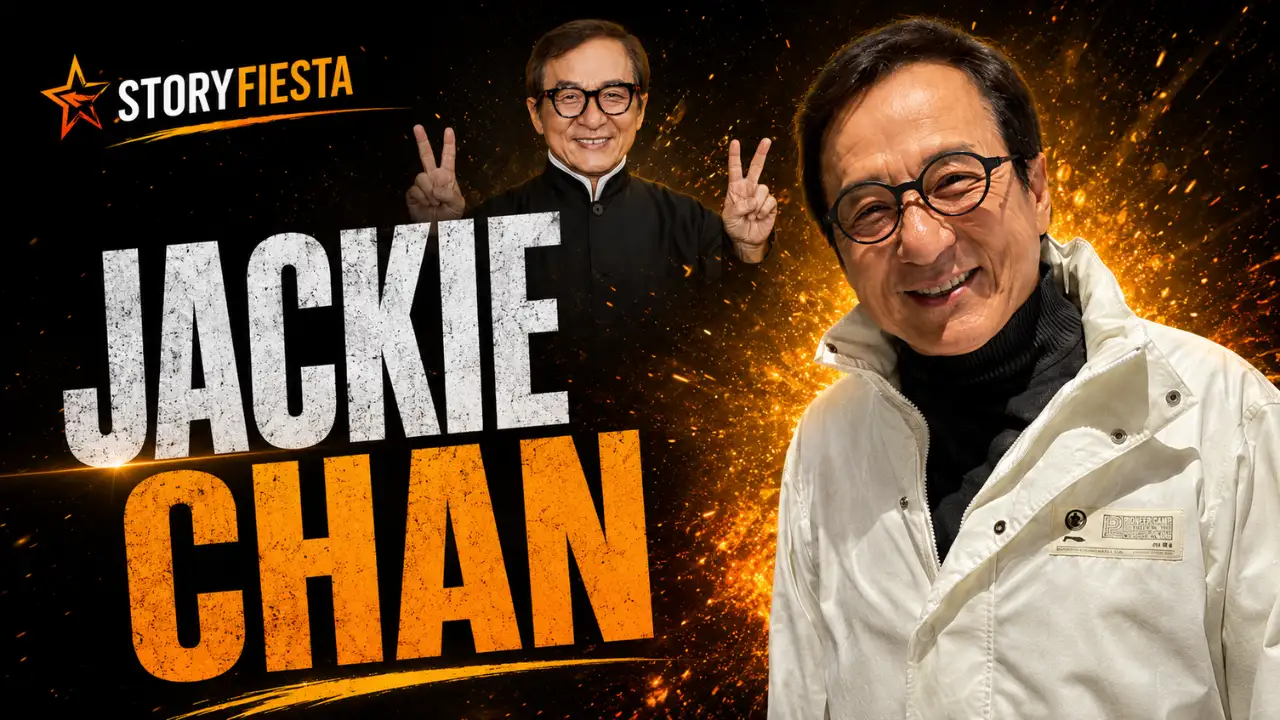
Jackie Chan developed a style of screen action that depends on more than martial-arts technique. Physical comedy, character interaction, practical movement, and imaginative use of everyday objects became central to his work. That approach grew from demanding childhood training and a deliberate decision not to imitate the established action stars who came before him.
His career has also expanded beyond performing. Institutional records recognize his work as an actor, director, writer and stunt performer. At the same time,e his more recent interviews describe how he continues to adapt his physical methods, work with a stunt team and pass practical knowledge to younger performers.
Training That Created a Physical Foundation
Hong Kong was the birthplace of Jackie Chan on April 7, 1954. At approximately seven years old, he entered the China Drama Academy, where he spent around a decade studying Peking Opera. According to the Academy of Motion Picture Arts and Sciences, that training covered acrobatics, martial arts, acting and singing.
These disciplines gave him a broad performance foundation. His physical education was not limited to learning how to fight. It also required control of movement, rhythm, expression and stage presentation. Those connected skills later allowed him to treat action as a form of performance rather than a simple exchange of punches and kicks.
The experience also placed physical preparation at the center of his professional identity from an early age. Chan’s later screen method drew on the ability to coordinate timing, movement, and reaction while remaining aware of how an audience would read a scene.
Refusing to Become Another Bruce Lee
Chan has said that the film industry initially attempted to position him as another Bruce Lee. Instead of continuing along that path, he concluded that he needed to establish a separate identity.
His solution was to combine martial-arts movement with comedy and character-driven reactions. Rather than presenting every encounter with complete seriousness, he could incorporate surprise, frustration, timing, and physical mistakes into the action. Ordinary surroundings became part of the choreography, allowing furniture and other objects to shape how a sequence unfolded.
That creative choice helped shape the distinctive rhythm of his performances. The humor did not sit outside the action as a separate element. It emerged from movement, obstacles, and the way his characters responded to difficulty.
Chan described this choice during a 2025 conversation with the Locarno Film Festival. He described the change as a conscious professional decision: instead of trying to reproduce another performer’s established image, he built an approach around his own strengths.
Major institutions later recognized the wider body of work that emerged from this distinct creative approach. The Academy credits him not only as a performer but also for directing, writing, and stunt work, all of which contributed to the development of his screen language.
Building Action Through Teamwork and Experimentation
Although Chan is closely associated with practical stunt performance, he describes action filmmaking as a collaborative process. The Jackie Chan Stunt Team has played a central role in developing, rehearsing, and performing physical sequences.
In a May 2025 interview with WIRED, Chan described training sessions of about three hours with members of the team. Those sessions include punching, kicking and physical rehearsal, but they also involve discussion. The group considers how choreography can differ from earlier work and how particular objects might be incorporated into a sequence.
A chair or board, for example, is not simply background decoration. The team studies how each element can shape movement and introduce a fresh physical challenge. This process connects experimentation with preparation, making the environment part of the action.
Chan has also discussed choosing performers according to their particular abilities. Different members may be suited to different movements, which allows the team to distribute work according to skill rather than treat every stunt as interchangeable.
At Locarno in 2025, he spoke about supporting younger stunt performers and passing professional knowledge forward. That responsibility has become part of his current work. His established techniques are not presented as a fixed formula; they are practiced, discussed, and adjusted within a working team.
Adapting His Methods Without Abandoning Practical Action
Chan continues to perform physical action, but his own interviews provide a more qualified picture than the familiar claim that he performs every stunt personally. He told WIRED that he still completes movements suited to his abilities, while specialists handle tasks requiring separate expertise. He used piloting a helicopter as an example of work that should be left to a trained professional.
Age has also changed the complexity of the movements he attempts. Chan explained that where he might once have performed a combination involving several kicks, he can now simplify it to one effective movement. The goal is not to pretend that his physical capacity has remained unchanged. It is to adapt the presentation while preserving the qualities audiences associate with his work.
In a separate 2025 interview with Haute Living, he described decades of training as a form of muscle memory. Preparation remains embedded in his professional habits, even when a current performance does not require him to begin training from the start.
His preference for practical action also remains clear. Chan acknowledged that digital effects and wirework can help performers achieve movements that would otherwise be difficult or impossible. At the same time, he believes extensive technological assistance can weaken the audience’s sense of genuine physical risk.
That position does not mean rejecting every modern production tool. His comments describe a preference for retaining practical performance where it can be completed responsibly, supported by specialists and shaped around his present abilities.
Recognition for a Distinctive Body of Work
The Academy’s Board of Governors voted on August 30, 2016, to present Chan with an Honorary Award. He received the award at the Governors Awards on November 12, 2016.
The recognition covered a body of work extending across acting, directing, writing and stunt performance. It was an Honorary Academy Award rather than a competitive acting prize, emphasizing his broader contributions to motion-picture work.
A further career tribute followed in 2025. On August 9, the Locarno Film Festival presented him with the Pardo alla Carriera, an award supported by Ascona-Locarno Tourism. The festival accompanied the presentation with retrospective screenings and a public conversation about his professional development.
That discussion allowed Chan to explain the choices behind his work, including his refusal to remain an imitation of another action star and his reliance on collaboration with stunt performers.
The two honors came from different institutions and at different stages of his career. Both honors acknowledged his wider creative contribution, particularly his work in designing and directing physical action.
Using Public Recognition Beyond Entertainment
Chan launched his charitable foundation in 1988. UNICEF’s institutional profile says he subsequently worked with charitable organizations in Hong Kong and internationally.
During a visit to Cambodia in 2004, UNICEF appointed him as a Goodwill Ambassador. Its current directory continued to list him in that role in July 2026.
His UNICEF advocacy has addressed problems affecting children, including landmines, HIV/AIDS, avian influenza, natural disasters and barriers to education. His documented role has centered on public engagement and raising awareness rather than personally administering UNICEF programs.
A difficult family experience also influenced another area of his advocacy. In 2015, Reuters reported Chan’s remarks at the beginning of his work as an anti-drug ambassador in Singapore. He said his son’s drug detention had caused him anger and shame and made him more determined to oppose drug use.
Chan presented that experience as a personal shock that changed the urgency of his public message. His comments connected an issue inside his family with a decision to speak directly to young people about drugs.
Looking Back While Continuing to Work
Recent interviews show Chan examining both the opportunities and shortcomings of his earlier years. When asked what advice he would give his younger self, he said he wished he had studied more, particularly English and piano.
The comment offers a direct account of personal regret without diminishing the value of his physical education. His early training created the foundation of his profession, but he now recognizes areas of learning that he would have approached differently.
Chan has also spoken about using international filmmaking to share martial arts and Chinese culture with wider audiences. In a 2025 interview with People, he expressed hope that films could encourage connection rather than division. That is his stated intention for the work, not a claim that every production has produced the same response.
His professional activity remained visible in 2025 through a Columbia Pictures release, international promotional appearances and the Locarno career tribute. At the same time, his interviews focused less on preserving an image of unlimited physical ability and more on adaptation, teamwork and transferring knowledge.
The result is a different kind of continuity. Chan remains involved in physical performance, but he is also increasingly positioned as an experienced practitioner who explains how action is designed and helps younger performers develop their skills.
A Screen Language That Remains His Own
Jackie Chan’s distinctive approach grew from the meeting of several verified influences: long physical training, a refusal to imitate Bruce Lee, an interest in comedy and a collaborative method of building action around movement and ordinary objects.
That method has changed with age. Complex movements can be simplified, specialist work can be assigned to appropriately trained professionals, and technology can be used where necessary. The central principles, however, remain practical performance, precise timing, and experimentation with the surrounding environment.
His Honorary Academy Award and Pardo alla Carriera recognized the breadth of that work, while his stunt-team mentorship points toward its continuation through other performers. Beyond production, his foundation and UNICEF role have given him established channels for humanitarian advocacy.
Chan did not create his professional identity by following an existing action model. He developed a language suited to his own abilities and has continued refining it through collaboration, adaptation, and teaching.