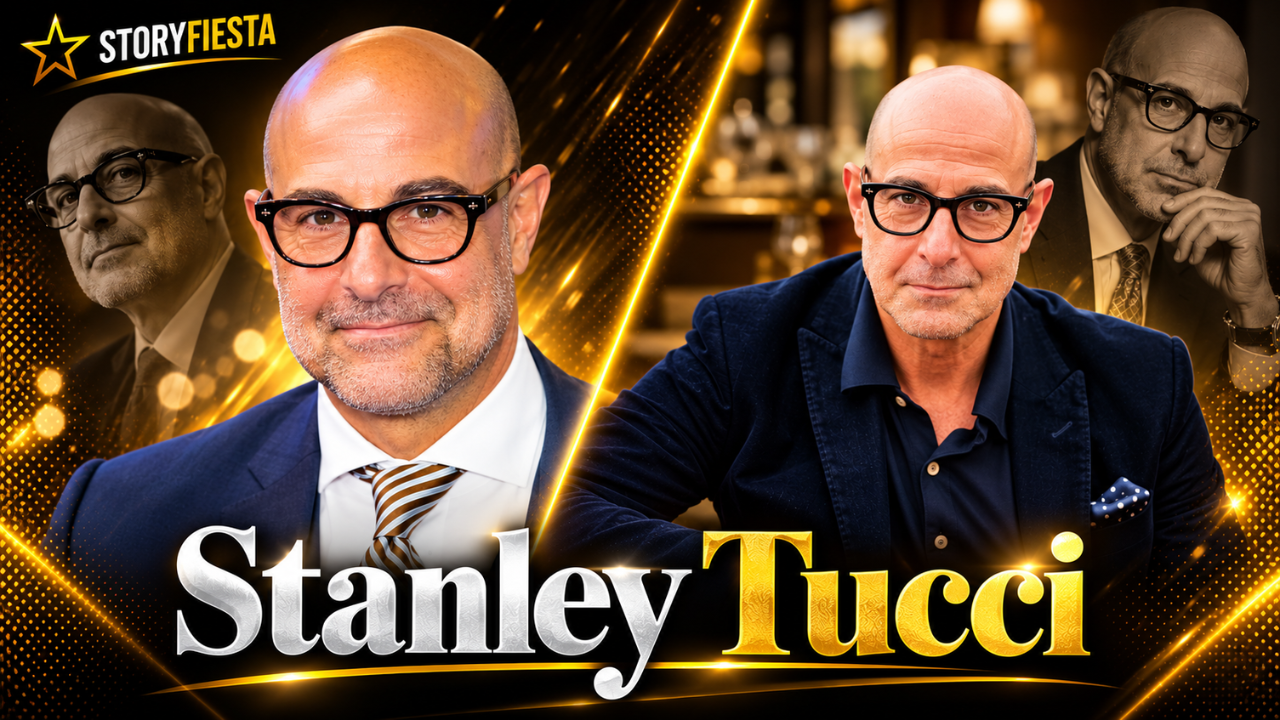
Stanley Tucci has developed a substantial body of public work around food, writing, travel, and Italian regional culture. What began with family-rooted cooking and published recipes eventually expanded into memoir, extensively researched nonfiction programs, humanitarian initiatives, and cultural reporting.
His interest in food is not simply a recent extension of his public profile. Tucci was publishing cookbooks more than a decade before his latest Italian travel projects, and his writing repeatedly connects meals with family memory, regional identity, loss, migration, and everyday life.
That record gives readers a different way to understand Stanley Tucci: not simply as a recognizable public figure who enjoys food, but as an author and presenter who has spent years using cuisine to explore people and places.
| Category | Details |
|---|---|
| Public work | Author, food writer, nonfiction presenter and producer |
| Education | Purchase College alumnus |
| Culinary focus | Italian cooking, regional traditions and food culture |
| Humanitarian role | UNHCR high-profile supporter |
| Emmy record | Seven wins and 15 nominations in the Television Academy database |
| Cultural work | Food, travel, regional history and contemporary Italian identity |
How Food Became a Serious Part of Stanley Tucci’s Public Work
Tucci’s documented culinary work predates the food-and-travel programs that later brought this side of his career to a larger audience.
Gallery Books published The Tucci Cookbook in 2012. The book brought together nearly 200 recipes, along with stories and traditions tied to his family’s Italian cooking. Rather than treating food simply as a collection of dishes, the book placed recipes within a family context.
Two years later, Tucci and Felicity Blunt co-authored The Tucci Table: Cooking With Family and Friends. Published in 2014, it incorporated Italian, British, and American influences and again presented cooking as something tied to the household and shared meals.
These books established a culinary publishing record well before his later nonfiction travel work. They also introduced themes that would continue through his later projects: family memory, regional traditions and the social importance of eating together.
His food writing later moved beyond recipes. In 2021, Taste: My Life Through Food used meals to structure memories of childhood, family experiences, work, loss, and major life changes. The 2024 memoir What I Ate in One Year (and related thoughts) returned to a similar idea, organizing reflections on travel, aging, grief, and changing family circumstances around the meals of a single year.
Food, in other words, became both a subject and a way to tell a larger personal and cultural story.
Why Tucci Uses Food to Explain Memory, Family, and Identity
Tucci’s books and interviews consistently present food as something closely connected to memory.
In Taste, meals provide a route into experiences from different periods of his life. What I Ate in One Year continues that approach through everyday encounters with cooking and eating, including meals involving children, parents, and several generations of family.
That connection also appears in the way Tucci talks about Italy. In a 2025 Reuters interview, he explained that traveling through the country sometimes brings him into contact with people whose expressions, behavior, or mannerisms remind him of relatives from childhood. Those encounters connect regional travel with memories of family members who are no longer alive.
Tucci has also described food as common ground. Speaking with National Geographic in 2025, he argued that divisions involving politics, ideology, religion, and money can separate people, while sharing food can create opportunities for connection.
His view of culinary tradition is not entirely preservationist. In the same interview, he supported innovation when it grows from an understanding of established recipes rather than being pursued simply for novelty.
Those ideas help explain why his work often places a meal within a wider story. A regional dish may lead to a discussion of family, local history, migration, or changing traditions rather than remaining only a description of ingredients.
How Italian Regional Culture Became Central to His Nonfiction Work
Italian regional identity became increasingly important to Tucci’s nonfiction projects.
Stanley Tucci: Searching for Italy explored the country through regional cuisine, using food to introduce viewers to history and cultural differences. The program won the Emmy for Outstanding Hosted Nonfiction Series or Special in 2021 and again in 2022.
That approach continued with Tucci in Italy, which began in 2025. Its first season traveled through Tuscany, Lombardy, Trentino-Alto Adige, Abruzzo and Lazio, combining food with local people, landscapes and regional traditions.
Tucci has said the underlying idea had been developing for roughly two decades. National Geographic reported on the history while discussing the series’ launch in 2025, although it did not give a precise start year.
His stated purpose goes beyond displaying well-known Italian dishes. He has described food as a way of understanding the country itself, including differences between regions and the social histories behind local traditions.
By 2026, he was also speaking directly about the danger of reducing Italy to a single familiar image. In an interview connected with the second season of Tucci in Italy, Tucci said he wanted audiences to encounter regions and traditions they might not already know and to gain a broader picture of contemporary Italy.
That regional approach is central to the project. Instead of presenting Italian cuisine as one uniform tradition, the programs emphasize that different areas have their own foods, histories, landscapes, and cultural influences.
What Goes Into Tucci’s Food and Culture Projects
The finished programs can appear informal, but Tucci has described a lengthy research process behind them.
In a 2026 Disney+ interview, he said developing a season can take close to a year. Ideas may begin with a restaurant he has visited, a person he knows, something he has read, or a subject he wants to investigate.
Researchers then help develop those possibilities and determine how to balance different stories within each region.
Tucci also contributes directly to that process. His description of the work suggests he helps suggest locations, people, and subjects rather than appearing only after the editorial work is done.
That preparation helps explain why individual episodes can move beyond food itself. A meal may become the starting point for discussing local history, regional differences, migration or the preservation of traditional practices.
Tucci has also described hosting as personally exposing because the format requires him to appear as himself.
His everyday habits reinforce how closely food is tied to the work. In a 2025 interview, he said that when arriving somewhere new, thinking about what and where to eat is among his first concerns.
He has similarly described a preferred daily rhythm built around work, exercise, cooking, and spending the evening eating or having a drink with other people before returning to work the following morning. It is a personal preference rather than a fixed schedule, but it fits the broader place food occupies in his writing and professional projects.
How Cancer Treatment Changed His Relationship With Food
Tucci’s relationship with food was significantly affected by a serious health experience that he has discussed himself publicly.
He has said that he was diagnosed in 2017 with a rare cancer at the base of his tongue. According to his own account, treatment involved high-dose radiation and chemotherapy.
Tucci has said the treatment left him unable to eat normally and that he relied on a feeding tube for six months.
In a 2025 interview with People, he said his sense of taste and smell eventually returned and felt stronger to him than before treatment. Some lasting difficulties remained, however. He said swallowing certain tough foods could still be difficult and that eating sometimes took considerably longer.
These details come from Tucci’s own interviews and memoir-related accounts, not publicly released medical records.
His experience adds context to his later food work because he couldn’t take eating for granted during treatment. At the same time, his own recent comments indicate that describing the experience as having left no lasting effects would be inaccurate.
How His Food and Cultural Work Expanded Into Advocacy and Public Projects
Food has also appeared in Tucci’s humanitarian work.
The UN Refugee Agency identifies him as a high-profile supporter who has worked with UNHCR since 2017. His refugee-related work has ranged from public awareness and fundraising initiatives to backing UNHCR campaigns and the 2019 Global Refugee Forum.
In 2018, he participated in a World Refugee Day food initiative that connected cooking with themes including displacement, memory, integration and belonging.
As part of UNHCR-related work, Tucci cooked alongside Syrian refugee and UNHCR supporter Maya Ghazal. The initiative used food to discuss how family recipes and culinary traditions can travel with people displaced from their homes.
His official UNHCR designation is high-profile supporter, not Goodwill Ambassador.
Tucci’s role as an interpreter of Italian culture also expanded into another major international event in 2026. NBCUniversal selected him as a contributor for its Milan Cortina Winter Olympics coverage.
His assignment focused on northern Italian food, traditions, history, landscapes, and lifestyle. NBC announced the role in September 2025 and documented his participation during the February 2026 Games.
The work placed the same themes found in his books and travel programs into a different setting: using food and local traditions to help explain a region to a broad audience.
What His Recent Work Shows About This Second Career
Tucci’s food-and-culture work remained active through 2026.
The second season of Tucci in Italy expanded the project into Naples and Campania, Sicily, Le Marche, Sardinia and Veneto. Release timing differed by territory and platform, with U.S. and UK schedules not using the same premiere date.
The regional expansion continued the program’s central idea: Italy is better understood as a collection of distinct local cultures rather than through a single national stereotype.
The project also received formal recognition. On September 5, 2026, Tucci won the Emmy in Italy for Outstanding Hosted Nonfiction Series or Special, with Tucci credited as executive producer and host.
That award also changed an easily outdated biographical detail. Some publisher material still describes him as having six Emmy wins because it predates the 2026 result. The Television Academy’s current record lists seven Emmy wins and 15 nominations.
By 2026, Tucci’s food-and-culture work had developed into a sustained professional track spanning publishing, researched nonfiction, humanitarian collaboration, Olympic cultural coverage, and Emmy-recognized hosting.