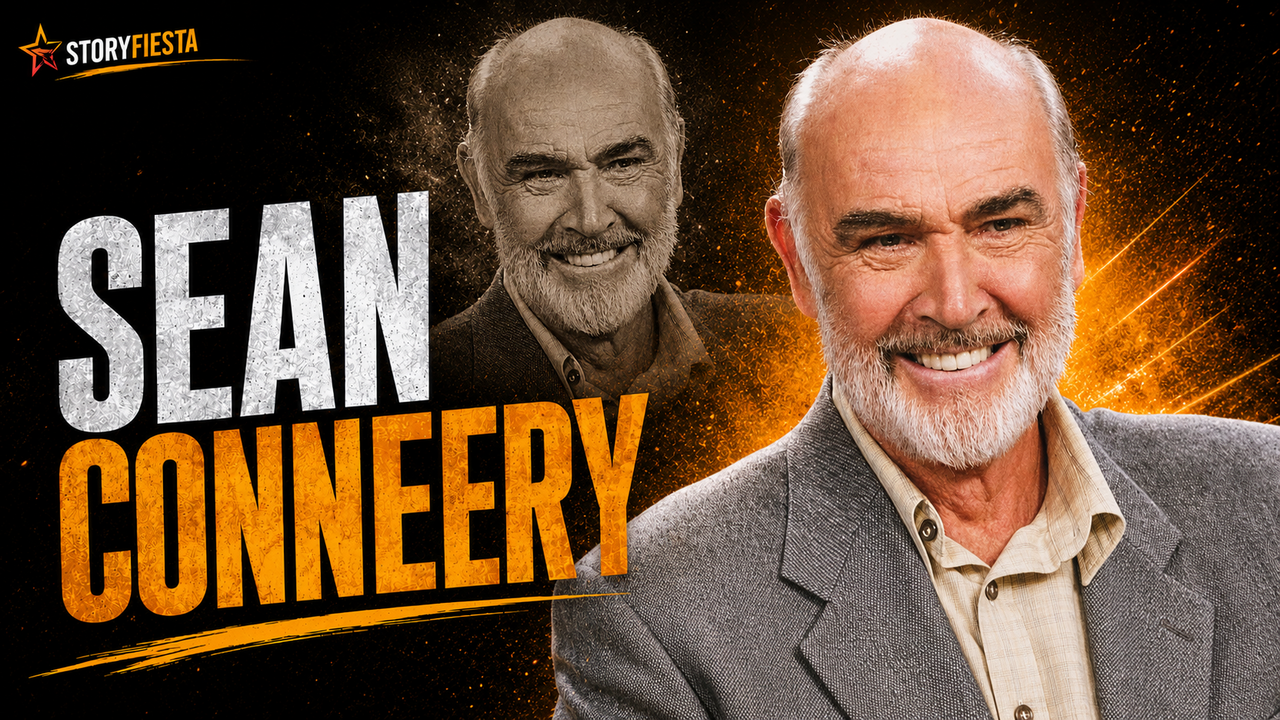
Sean Connery became internationally recognized as the first actor to play James Bond in the official cinema series. Yet one of the clearest links between that success and his Scottish background appeared away from the screen. He used his earnings from Diamonds Are Forever to support the Scottish International Education Trust, which he co-founded in 1971.
The choice brought several important chapters of his life together. Connery had left school early, educated himself through reading and theater, and retained a strong attachment to Scotland throughout his career. His support for education later became a legacy that now includes a major filmmaking prize and a talent program bearing his name.
From Working-Class Edinburgh to Self-Education
Thomas Sean Connery was born in Edinburgh in August 1930 and raised in a working-class household. He was the older of two boys and left school early to begin working full time. At 16, he joined the Royal Navy and remained in the service for approximately three years before returning to civilian life.
Those beginnings were materially limited, but Connery did not later describe his childhood solely in terms of hardship. While accepting the American Film Institute Life Achievement Award in 2006, he recalled that he had little sense of lacking anything as a child because he had nothing to compare his circumstances to. It was a personal reflection rather than an attempt to deny the limits his family faced.
Formal schooling ended early, but his education did not. In a 1992 interview, Connery described visiting libraries across Britain and Ireland while touring with a production of South Pacific. When the production was not performing, he tried to attend plays. He later identified books and reading as experiences capable of changing a person’s life.
That period gave him a self-directed route into subjects and ideas he had not encountered at school. Reading and watching stage performances became part of his preparation while he was still developing professionally. His later investment in educational opportunities for other Scots therefore had a personal connection to the way he had expanded his own knowledge.
Bond Created International Success
Connery became the first actor to portray James Bond in the official cinema series when Dr. No was released in 1962. Between 1962 and 1971, he played Bond in six EON productions, beginning with Dr. No and ending with Diamonds Are Forever.
The total is sometimes given as seven. That figure includes Never Say Never Again, an independently produced Bond feature released in 1983. The accurate distinction is that Connery appeared in six EON Bond productions and seven Bond feature films overall.
The role created an extraordinary level of public attention. In a 1987 interview with Barbara Walters, Connery compared his experience of Bond-era fame to living in a goldfish bowl. He spoke about media attention becoming intrusive during international travel and described encounters in which ordinary personal space was difficult to maintain.
His comments were directed at the pressures surrounding enormous fame, not simply at audiences or at every aspect of playing Bond. He had become closely identified with one character while also trying to build a wider body of work. The financial rewards of that success, however, eventually supported a project far removed from celebrity.
Turning Bond Earnings into Educational Support
The Scottish International Education Trust identifies Connery as one of its founders, alongside racing driver Sir Jackie Stewart. Its official history records that the organization was established in 1971 to support educational opportunities for people from Scotland.
An archival source dates the trust’s founding to 1970, while the organization itself uses 1971. The earlier date may relate to its planning or initial formation, but the available records do not fully explain the difference. Its own institutional history provides the stronger basis for describing 1971 as the establishment year.
Connery’s official website states that he donated his entire salary from Diamonds Are Forever to the trust. The site describes the payment as well over $1 million, although it does not display a contract or audited financial record establishing an exact figure. The donation itself is officially acknowledged, while the precise amount is less firmly documented.
Diamonds Are Forever was also released in 1971, by which point Connery’s association with Bond had brought him international recognition.
For readers familiar only with his screen roles, the trust adds an important dimension to his public record. Connery had relied on libraries, reading, and live performances to extend his own education after leaving school. His Bond earnings then helped create opportunities for other people from Scotland to pursue education and professional development.
Scottish Identity Shaped His Public Work
Connery continued to connect his professional identity with his upbringing. In a statement preserved by the American Film Institute, he said part of his strength as an actor came from staying close to his core self, including the voice and rhythm rooted in his background.
He did not remove his Scottish accent as his career became international. Instead, he viewed that recognizable voice as part of what he brought to his work. The comment offers his own explanation of the relationship between his origins and his screen presence without requiring a broader label for his personality.
His connection with Scotland also entered political debate. Connery publicly supported Scottish independence and argued in 2014 that it could create opportunities for the country’s arts and screen sectors. He linked the issue to cultural confidence and to Scotland’s ability to develop its creative identity. These were his stated expectations for independence rather than outcomes that were ever established.
Connery also received formal recognition in the United Kingdom. His appointment as a Knight Bachelor for services to film drama appeared in The Gazette on December 31, 1999, and his investiture followed in 2000. The two years sometimes appear separately in accounts because one marks the published appointment and the other the ceremony.
Recognition Beyond Bond
Although Bond remained the role most closely associated with Connery, major institutions recognized work from across his career. His performance in The Untouchables earned him the Academy Award for Actor in a Supporting Role at the ceremony held on April 11, 1988. The honor was tied to a single role rather than his complete body of work.
A decade later, the British Academy of Film and Television Arts named him a BAFTA Fellow in 1998. The Fellowship recognized his wider contribution to screen work.
The American Film Institute followed with its Life Achievement Award in 2006. During the ceremony, Connery spoke about the colleagues he had valued, emphasizing qualities such as talent, enthusiasm, industry, and a sense of enjoyment in the work. He also acknowledged his wife Micheline, other family members, and friends gathered for the occasion.
His retirement from regular screen acting is generally dated to that period. In 2007, he rejected a possible return for another Indiana Jones production and made clear that he considered himself retired. He later completed voice work, so retirement from regular screen acting is more precise than suggesting that he never performed again.
Connery was 90 when he died on October 31, 2020. His family and EON Productions confirmed his death. His educational and professional legacy has since continued through organizations and programs operating in his name.
His Educational Legacy Continues
In February 2024, the Sean Connery Foundation sponsored the Sean Connery Prize for Feature Filmmaking Excellence at the relaunched Edinburgh International Film Festival. The competition created a direct link between his name and financial support for emerging filmmakers.
The prize carries £50,000 to support the winning filmmaker’s future work. Rather than being selected solely by the foundation or Connery’s family, the winner is decided through an audience vote.
Jack King’s The Ceremony received the inaugural award on August 21, 2024. The competition returned in 2025, when Abdolreza Kahani’s Mortican won the prize. Its continuation beyond the first year established it as more than a single commemorative presentation.
Another program carrying his name has focused on training. Six short films created through the NFTS Sean Connery Talent Lab were selected for world-premiere screenings at the Edinburgh International Film Festival in 2025. The program extended the educational theme by connecting skills development with an opportunity to present completed work publicly.
These are posthumous initiatives managed by the foundation and participating institutions. They are not projects Connery personally administered, but they continue the connection between his name, Scotland, education, and opportunities for developing creative professionals.
Conclusion
Sean Connery’s Bond work brought international recognition and substantial financial success, but his use of that success reached beyond his own career. By helping to establish the Scottish International Education Trust and donating his Diamonds Are Forever salary, he linked his earnings to educational opportunities in Scotland.
His personal history gave that choice added context. He had left school early and relied on libraries, reading, and theater to continue learning. Decades later, his name remains attached to programs that provide money, training, and public exposure to emerging filmmakers. The continuing work of the foundation and Edinburgh International Film Festival has carried that educational connection into a new generation.