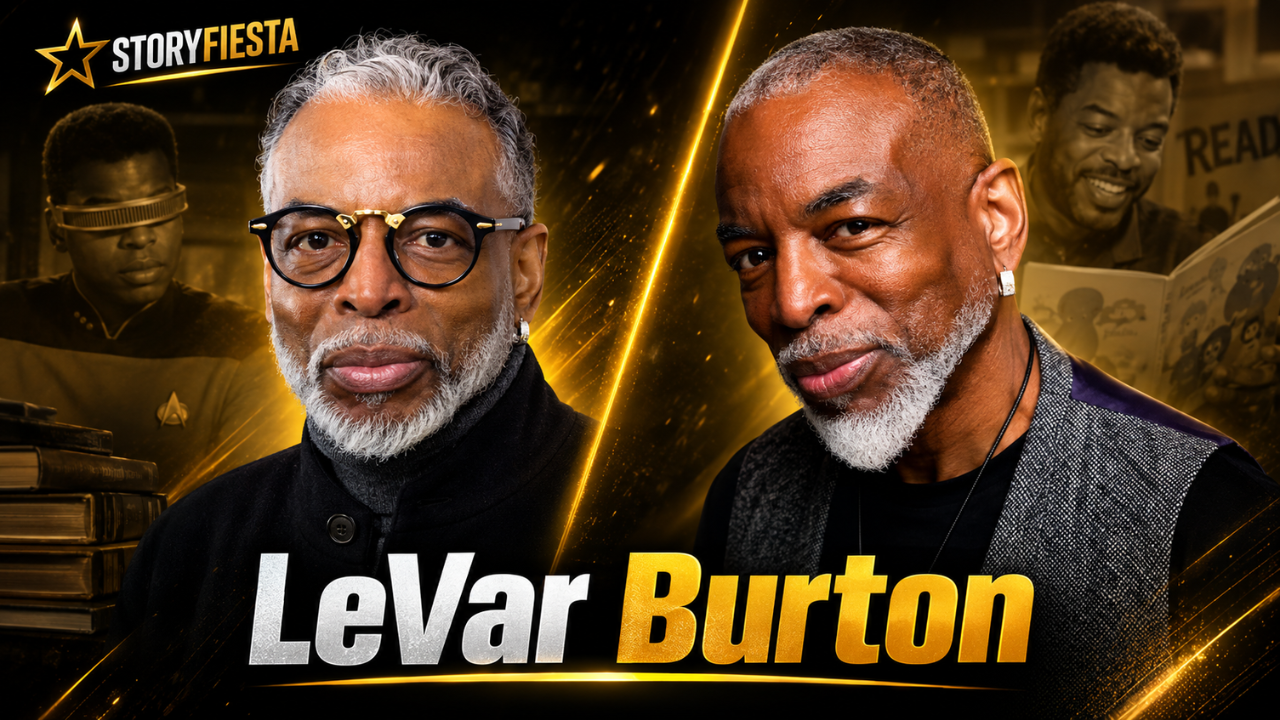
LeVar Burton has spent decades connecting storytelling with literacy, education, imagination, and access to books. He has described his children’s literacy work as the professional achievement he is proudest of, and his more recent projects show that reading remains central to his public work.
His approach goes beyond encouraging children to finish books. Burton has spoken about developing lifelong readers, helping young people use imagination, modeling reading at home, and treating media as a tool that can serve education when used deliberately.
| Category | Details |
|---|---|
| Public work covered | Storytelling, literacy, education, and reading advocacy |
| Literacy philosophy | Encouraging children who can read to become lifelong readers |
| Documentary work | Executive producer on a project about children’s reading instruction |
| Book-access advocacy | Served as honorary chair of Banned Books Week |
| Publishing work | Author and co-author of books for younger readers |
| Audio storytelling | Hosted a short-fiction podcast that concluded after roughly seven years |
| Federal recognition | Recipient of the National Humanities Medal |
Education and Family Influences Shaped Burton’s Approach to Reading
Burton has connected his commitment to literacy with the importance his family placed on education. In remarks at Stanford in May 2026, he said his mother had worked as an English teacher before becoming a social worker. He also credited his sister with teaching him to read.
In a Television Academy Foundation interview, he described education as something his mother viewed as an important tool for navigating life. He also recalled growing up in a family where service to other people was expected.
His path was not always aimed toward a career in storytelling. As a teenager, Burton attended St. Pius seminary while considering the priesthood. He later said exposure to philosophy, literature, an influential teacher, and a desire to experience a wider world helped him change those plans.
That background helps explain why education and service recur so consistently in his later public work. Rather than treating reading simply as an academic skill, Burton has spoken about it as a way to support independent learning and imagination.
Burton Wanted Reading to Become a Lifelong Habit
Burton has been clear about the purpose behind Reading Rainbow. Speaking at Stanford in 2026, he said its goal was not to teach children the mechanics of reading. Instead, the aim was to take children who could already read and help turn them into readers for life.
He made the importance of that work personal during a PBS conversation broadcast in January 2024. When discussing his professional accomplishments, Burton said he was proudest of Reading Rainbow because of its connection with generations of readers.
His advice to parents and educators follows the same philosophy. At Stanford, he encouraged adults to begin with what children are already passionate about. A strong interest in a subject, he argued, can become a reason to keep reading and learning.
He also stressed the importance of adults modeling the behavior they want children to adopt. If children are expected to value books, Burton believes they should also see adults reading.
For him, reading is closely connected with imagination. He has described printed words as requiring readers to construct characters, places, and situations in their own minds. He also links lifelong reading with the ability to continue educating oneself beyond formal schooling.
Storytelling Expanded Into Books, Audio, and Literacy Projects
Burton’s literacy work has taken several forms beyond children’s broadcasting. He has written for younger readers, including A Kids Book About Imagination. His official website also identifies him as co-author, with Susan Schaefer Bernardo, of The Rhino Who Swallowed a Storm.
Audio storytelling became another important part of his work. LeVar Burton Reads featured short fiction and ran for roughly seven years. Burton announced that the project was concluding with its final story in May 2024, while distribution records place the last regular episode on May 7.
He also supported literacy-focused public education work as an executive producer on a project about children’s reading instruction.
Across these formats, Burton has continued to connect storytelling with broader values. His company describes its work as centered on community, empathy, diversity, and integrity.
Fred Rogers also influenced the way Burton thinks about communication. In direct interviews, Burton has described Rogers as both a mentor and a friend and has spoken about their discussions of television as a form of service. He has also connected Rogers’ influence with the importance of communicating with audiences authentically.
Burton returned to that idea of authenticity at Stanford in 2026. When asked, he explained that he had not been willing to give up who he was to satisfy others’ expectations.
Book Access Became a Larger Part of His Public Advocacy
Burton’s literacy work has also extended into public advocacy over access to reading material. In 2023, the American Library Association named him honorary chair of Banned Books Week.
The role placed him within a national campaign focused on intellectual freedom and access to books. Burton used the position to publicly support people’s ability to read and encounter a broad range of ideas.
His executive-producer work on a project about children’s reading instruction addressed another part of the literacy conversation: how children learn to read and the educational systems that support reading instruction. His public work has therefore extended beyond encouraging individual reading habits into broader discussions about access and literacy.
That work received federal recognition when Burton was named a 2023 National Humanities Medal recipient. The medal was formally presented at the White House on October 21, 2024. The National Endowment for the Humanities recognized his contributions to storytelling and literacy advocacy.
The award’s date can be confusing because the ceremony took place in 2024, but the honor itself belongs to the 2023 National Humanities Medal cohort.
His 2026 Public Work Continued the Same Literacy Mission
Burton’s May 2026 appearance at Stanford Graduate School of Education brought many of these ideas together. During the Cubberley Lecture, he discussed reading, imagination, teachers, technology, family influences, and lifelong learning.
His view of technology is not simply oppositional. Burton said technology can support education when people use it intentionally. He has also argued that media always communicates something, so it’s important to consider what people learn from it.
The Stanford discussion also reinforced his belief in imagination as a core part of reading. Rather than seeing digital tools and books as automatically competing forces, he focused on using media deliberately while preserving the mental work reading asks of the individual.
In July 2026, Burton spoke with AARP about storytelling, education, Fred Rogers, and personal growth. He also discussed his relationship with his father, explaining that contact had been limited after his parents separated. About five years before his father’s death, Burton said he began conversations intended to make sure important things were not left unsaid. He later described reaching a sense of completion about that relationship.
His next major publishing project is Take My Word for It, written with Tracey Michae’l Lewis-Giggetts and scheduled for release on November 10, 2026. As of September 2026, the memoir remains forthcoming.
Burton is also scheduled to appear at the National Council of Teachers of English Annual Convention in Philadelphia on November 21, 2026, where the current program lists him for a featured fireside chat.
Those current projects continue the same themes that appear throughout his public work: reading as a lifelong practice, storytelling as a form of connection, and education as something that extends beyond the classroom.
StoryFiesta has also covered children’s literacy through Debby Clarke Belichick’s documented involvement with a program that incorporated books into pediatric healthcare visits.