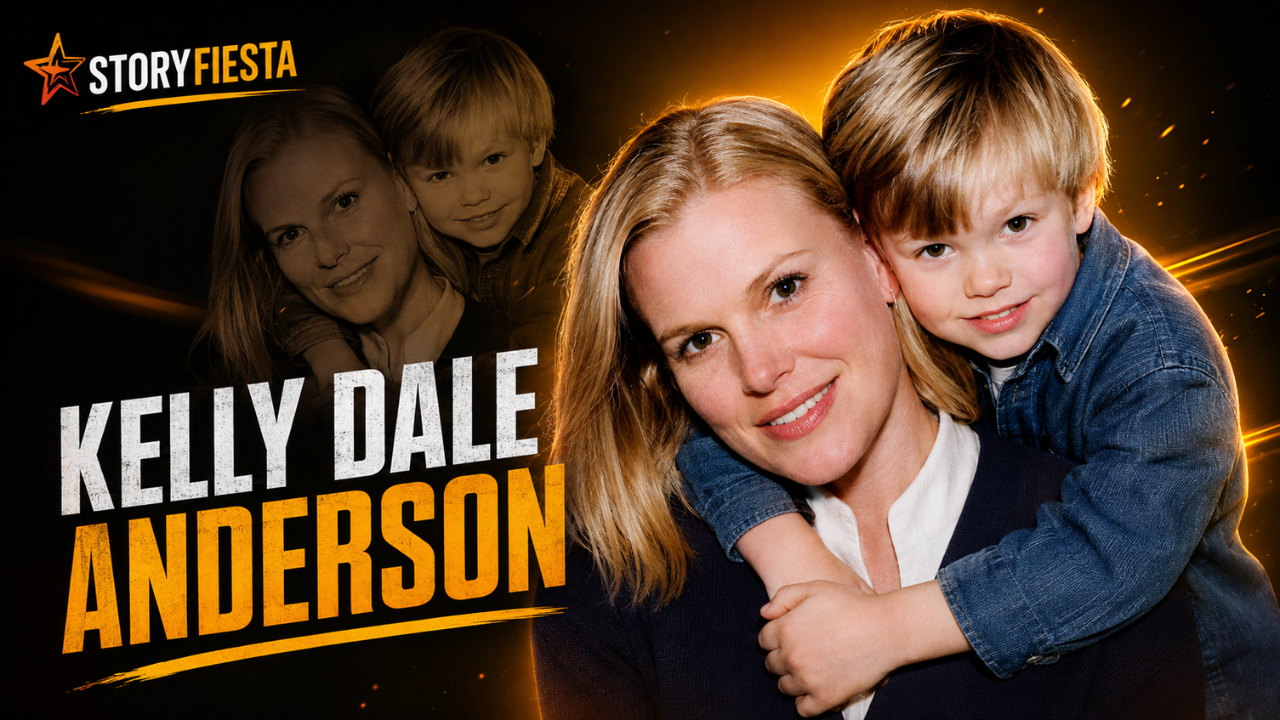
Kelly Dale Anderson is the birth name of the woman later known publicly as Kilauren Gibb. Born in Toronto in 1965, she was adopted as an infant by David and Ida Gibb, two teachers who gave her the name she grew up with.
She learned about her adoption as an adult and spent approximately five years seeking information about her biological family. That search led to a widely reported reunion in 1997. Her own interviews from that period provide the clearest account of her upbringing, motivation, and response to discovering her family history.
| CategoryDetails | |
|---|---|
| Birth name | Kelly Dale Anderson |
| Adoptive name | Kilauren Gibb |
| Birthplace | Toronto, Ontario, Canada |
| Adoptive parents | David and Ida Gibb |
| Biological parents | Joni Mitchell and Brad MacMath |
| Adoptive sibling | David Gibb |
| Children | Marlin and Daisy |
| Documented profession | International model |
Her Adoption Established the Name Kilauren Gibb
Reputable publications report that Kelly Dale Anderson was born in Toronto on 19 February 1965. Researchers could not locate a publicly accessible civil birth record, so the exact date comes from established reporting rather than an institutional register.
As an infant, she was adopted by David and Ida Gibb. Both were Toronto teachers, and they already had a son named David. Following the adoption, Kelly received the name Kilauren Gibb, which reliable sources have continued to use when referring to her adult life.
Most detailed reports say she was adopted at approximately eight months old. An early Wired account used the less precise description of about a year after her birth. Without an accessible adoption record, the most accurate summary is that the adoption occurred during infancy, reportedly when she was around eight months old.
Her biological mother is Joni Mitchell. Time and People identify her biological father as Toronto photographer Brad MacMath, although some archived reports spell his surname McMath. Those two publications support the spelling MacMath.
The adoption connected Kelly Dale Anderson with two different family histories, but her later interviews did not treat one as a replacement for the other. She spoke appreciatively about the home where David and Ida Gibb raised her, while also explaining why she wanted to understand her biological background.
She Learned About Her Adoption at 27
Gibb said she had wondered about her earliest years long before receiving a direct explanation. As a teenager, she noticed that the family photograph albums did not contain pictures of her before she was approximately eight months old. Her mother offered ordinary explanations, including that parents sometimes take fewer photographs of a second child, but the absence remained in her mind.
Her adoptive parents eventually told her she was adopted when she was 27 and pregnant. That disclosure occurred around 1992 and became the starting point for a more determined search for information about her origins.
In her 1997 interview, Gibb described David and Ida as loving and nurturing parents. She believed they had delayed telling her because they wanted to protect her, did not want her to feel like an outsider, and feared that the information might disrupt their relationship with her.
She also gave a strongly positive account of her childhood. Rather than describing her search as a rejection of her adoptive family, she expressed gratitude for what she considered a happy, grounded upbringing. Her comments distinguish her interest in her biological history from her relationship with the parents who raised her.
Pregnancy added a practical dimension to the disclosure. Contemporary reporting stated that she wanted access to relevant family and health information as she prepared to have a child of her own. She contacted the Children’s Aid Society and began a search that would take approximately five years to produce a decisive answer.
Her Five-Year Search Produced Answers in 1997
The adoption process did not immediately provide Gibb with the names she wanted. According to her account, the Children’s Aid Society placed her on a waiting list. On 31 January 1997, she received a package containing non-identifying information about her biological parents.
The material offered general descriptions rather than explicit identities. She recalled receiving details such as dates, heights, family background and personal history. After considering the information, she began comparing it with publicly available biographical material that friends believed might be relevant.
Gibb said she found approximately 14 or 15 corresponding points. The collection of similarities persuaded her that she had probably identified her biological mother, but contact was not immediate. Numerous other people had made unsupported approaches, so representatives examined the information before putting the two women in direct contact.
They first communicated by telephone. Gibb then traveled to Los Angeles with her young son, Marlin, for an extended visit that reportedly lasted 19 days. Their first reunion came in 1997, ending over 30 years of separation following the adoption.
Speaking shortly afterward, Gibb said the meeting brought her considerable relief. She described feeling whole and complete after finally obtaining the answer she had pursued for years. She also emphasized that she had entered the search without professional or financial expectations. Her stated purpose was to find her mother.
The 1997 interviews remain important because they preserve her own assessment of the experience. Later profiles have often retold the story, but the contemporary accounts show how she understood the search, her childhood, and the reunion as it happened.
The Reunion Expanded Her Family Record
Marlin was approximately three or four when he accompanied his mother to the initial meeting. Contemporary reports differ slightly on his age, but they agree that his presence meant the reunion brought more than one generation of the family together at once.
Gibb subsequently met her biological father, Brad MacMath, in April 1997. MacMath discussed that meeting directly with Time, describing the unexpected arrival of an adult daughter and grandson in his life.
Reliable reporting also indicates that Gibb has two paternal half-siblings: one half-sister and one half-brother. The reviewed material did not establish their identities or current circumstances strongly enough to include them in a responsible public profile.
Her immediate family later included a daughter named Daisy. Gibb appeared with Marlin and Daisy in a 2002 PBS documentary interview. People also identified both children in its 2024 profile, providing reputable confirmation of their place in the documented family record.
Little dependable recent information exists about their adult lives, and the available reporting does not establish the current state of Gibb’s wider family relationships. The verified record is strongest on the events surrounding the 1997 reunion and the family information publicly confirmed during the following years.
Her Verified Background Includes Modeling and Education
Before the reunion brought widespread attention to her identity, Gibb had developed a professional and educational record of her own. She told a Toronto interviewer that she began modeling after being noticed during a family holiday in Jamaica in 1979.
She described working as a model for ten years and traveling to Paris, New York and Australia. The Los Angeles Times instead reported a 13-year international career. The difference may result from rounding or different interpretations of when the work began and ended. Describing the period as roughly a decade preserves the common factual core of both accounts.
Her education received renewed attention in 1997 because she was then studying desktop publishing at George Brown College. Contemporary reporting noted that she was supporting her studies through student loans.
The Los Angeles Times also reported that she attended the University of Toronto and spent one year taking drama and psychology classes at Harvard University. The available material does not identify a degree earned at any of these institutions, so her record supports attendance and coursework rather than claims of graduation.
These professional and educational details are historical. No dependable recent source establishes her present occupation, employer, or professional project. They nevertheless provide useful context for the life she had built before her biological identity became a matter of international public interest.
Kelly Dale Anderson and Kilauren Gibb Are One Documented Identity
Kelly Dale Anderson was the name given to her at birth, while Kilauren Gibb became her identity after adoption. That distinction answers the central confusion surrounding the two names: they do not refer to separate people.
Her documented history follows a clear sequence. She was adopted during infancy, raised by David and Ida Gibb, learned about the adoption at 27, and spent approximately five years searching for information. In 1997, non-identifying records and a series of matching family details helped her establish contact with her biological family.
Her own statements also prevent the story from being reduced to the reunion alone. She spoke warmly about her adoptive parents, credited them with providing a happy childhood, and explained that her search began without expectations beyond finding her mother. Her professional background included international modeling, followed by further study documented around the time of the reunion.
Reliable reporting published since then has largely revisited those established events. It has not supplied a verified current occupation, residence, social-media presence or detailed account of her present lifestyle. The most dependable profile of Kelly Dale Anderson therefore remains the one supported by her direct 1997 testimony and the contemporaneous record of how Kilauren Gibb learned and confirmed her biological identity.