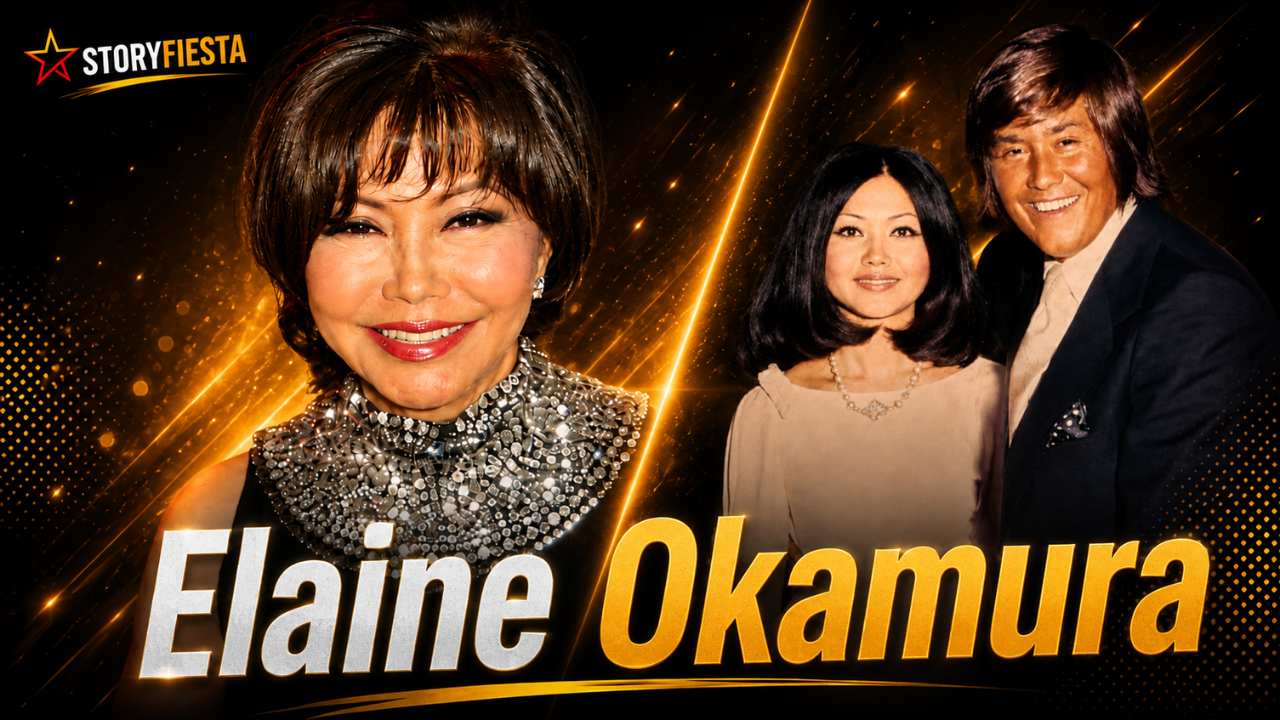
Elaine Okamura is widely recognized as Wayne Newton’s former wife, but her documented history began far from Las Vegas. Born and raised in Honolulu, she studied Japanese, trained for the demanding responsibilities of international air travel, and worked as a Pan American World Airways flight attendant.
In a detailed 2021 oral-history interview archived by the University of Nevada, Las Vegas, she discussed her childhood, Pan Am career, marriage, family, and experiences of anti-Asian discrimination. Her account provides a fuller and more reliable picture of the woman behind the familiar celebrity connection.
| Category | Details |
|---|---|
| Full name | Elaine Mariko Okamura |
| Birthplace | Honolulu, Hawaii |
| Heritage | Japanese American |
| Siblings | Sixth of seven children |
| Profession | Former Pan Am flight attendant |
| Former husband | Wayne Newton |
| Child | One daughter, Erin |
| Later home base | Las Vegas |
Elaine Okamura’s Honolulu Childhood and Japanese Heritage
Elaine Mariko Okamura was born in Honolulu on 19 November 1943. She was the sixth of seven children in a family whose life centered on the grocery store operated by her parents.
Her father had traveled to Hawaii from Japan as a boy while searching for his own father. After taking different jobs, he opened a grocery store in an area where residents previously had to travel some distance to buy everyday supplies. Elaine’s mother worked alongside him. Their business supported the household and enabled most of their children to attend college.
Elaine remembered a simple and happy childhood near Waikiki Beach. Her surroundings included mango and plumeria trees, while swimming, fishing, and raising parakeets were part of her early life. She also accompanied the family’s grocery deliveries in a green truck.
Japanese culture remained present in her education. She attended Japanese school alongside her regular classes and learned to read and write katakana and hiragana. At the same time, she developed a strong connection to Hawaiian traditions. She learned hula, played the ukulele, and made leis from flowers growing near her home.
Although education was important in her family, Elaine acknowledged that she was not a strong student and did not complete college. She considered studying in Los Angeles, but an unexpected meeting in Honolulu moved her towards a different career.
How Elaine Okamura Joined Pan Am
Shortly before her twenty-first birthday, Elaine encountered Jackie Higa, a woman responsible for recruiting Pan Am flight attendants. Higa first checked whether she met the age requirement and spoke Japanese, then asked her to visit Pan Am’s Honolulu office.
Elaine explained that she spoke a mixture of Japanese and English rather than polished Japanese. Her language ability and suitability for the airline’s requirements were nevertheless enough to secure an opportunity. Pan Am hired her and required her to improve her Japanese as part of the process.
Training took place at the airline’s facilities in Kew Gardens, New York. Arriving from Hawaii during winter presented an immediate adjustment: she recalled having to buy a heavy coat and boots because she was unprepared for the cold.
The professional preparation went well beyond serving passengers. Trainees had to understand the aircraft, pass written examinations, operate emergency exits, and practice water evacuations. They learned how to descend evacuation slides and assist other passengers once they reached the water.
First-class service brought another set of responsibilities. Staff prepared meals in confined aircraft galleys, learned about appropriate drink service, and had to manage the standards associated with international travel during that period. Elaine passed the required examinations and received her Pan Am wings.
Her Japanese ability led to an assignment connected with Pacific routes. As a junior employee, she often received long international journeys lasting 11 or 12 days, while more experienced attendants selected shorter trips. She described those flights as a practical education in independence and adulthood.
Not every early experience was positive. On an assessment flight to Rome, a passenger touched her inappropriately. Elaine reported the incident, and the senior crew member intervened. She said it did not happen again.
Despite the challenges, she remembered her Pan Am years positively. International travel had been a childhood ambition, and the job allowed her to encounter countries and cultures that had previously existed only in her imagination.
Meeting Wayne Newton During an International Flight
Elaine met Wayne Newton while working aboard a flight that made an unscheduled stop in Saigon during the Vietnam War. He had been entertaining American troops and boarded the Pan Am aircraft for the onward journey.
She was working in the galley when she first became aware that he was among the passengers. Newton tried to speak with her and invited her to lunch during a stop in Hong Kong, but she declined. She also initially refused to provide her telephone number.
He eventually obtained the number through another flight attendant and contacted Elaine at her family home in Honolulu. Their first date took place in San Francisco, where he met her during one of her scheduled trips.
The courtship continued for approximately two and a half years. Elaine recalled that the proposal came around Christmas, followed by a comparatively short engagement. Her mother was concerned about her marrying someone whose profession involved public performance, but the wedding proceeded.
Elaine Okamura wed Wayne Newton at Las Vegas’s Little Church of the West on 1 June 1968. The date is supported by Elaine’s own account and contemporary Associated Press wedding photography.
Elaine’s Years in a Changing Las Vegas
Marriage brought Elaine into a Las Vegas that was still developing beyond its established resorts. She moved to the city in the late 1960s and lived with Newton at the Casa de Shenandoah property near Sunset and Pecos. She remembered the surrounding area as largely open desert.
Her recollections describe a city before Henderson, Clark County, and newer residential areas had grown together. Trips to Lake Mead or Mount Charleston required more planning, while areas later filled by homes and shopping centers were then undeveloped land.
Social customs were different as well. Elaine recalled that formal dinners involved long dresses and carefully arranged evenings at prominent hotels. She and her friends marked occasions that might seem unusually small by modern standards, but the gatherings followed the elaborate style associated with Las Vegas during the 1970s.
Newton’s political connections also placed the couple at fundraising events and White House functions. Elaine said they traveled to raise money for Ronald Reagan and attended presidential events. Editorial photography separately documents the couple at a White House event on 30 July 1982.
Her attendance at these functions formed part of her life during the marriage; there is no evidence that she held political office or an official party position.
The marriage ended in divorce in 1985. Elaine later referred conversationally to having been married for 20 years, although the confirmed wedding and divorce dates indicate approximately 17 years.
Motherhood and Later Family Connections
Elaine and Wayne became parents to one daughter, Erin. Reputable reporting has identified Erin as their adopted child, while Elaine discussed motherhood and their relationship directly in her UNLV interview.
The divorce caused a difficult period between mother and daughter. According to Elaine, Erin initially blamed her for the family’s separation and stopped speaking to her. Their relationship improved gradually as Erin grew older.
By 2021, Elaine described them as exceptionally close. They spoke or exchanged messages every day, and Erin reportedly regarded her mother as a best friend. That account documents their relationship at the time of the interview without establishing its present circumstances.
Extended family also influenced Elaine’s decision to retain Las Vegas as her home base. Her sister and several nephews lived nearby, creating the family unit she valued. She divided earlier periods between Las Vegas, Los Angeles and New York, but kept returning to Nevada.
Hawaii retained a different kind of importance. Elaine continued to call the islands home and considered the possibility of eventually retiring there. However, she made clear that this was an uncertain plan rather than a settled move.
Travel, Heritage and Elaine’s Changing Outlook
International travel remained important after her Pan Am career. Elaine lived for periods in Los Angeles and New York and spent three months each year in London for approximately three years. Before the COVID-19 pandemic restricted her movements, she described herself as having a strong desire to keep traveling.
The value she attached to those experiences was not limited to seeing new places. She considered conversations with people from other societies to be one of her most significant forms of education. Exposure to unfamiliar histories and cultures, she said, encouraged greater compassion.
Her interest continued through the news and cultural programs she watched at home. She spoke particularly about following NHK coverage to learn more about Japan and other parts of Asia.
Family history formed another part of that outlook. Elaine believed younger generations should understand where their relatives came from rather than allow that knowledge to disappear. Participating in an oral-history project gave her a way to preserve memories of her Japanese-American family, Pan Am employment, and earlier Las Vegas life for her grandchildren and later researchers.
Speaking About Anti-Asian Discrimination
Elaine also used the UNLV interview to address anti-Asian discrimination. Growing up in Hawaii’s large Asian-American community had not prepared her for some of the racial hostility she said she encountered elsewhere.
She recalled that Wayne Newton once declined an engagement in South Africa because racial rules would have prevented her from staying in the same hotel. On another occasion, she said a woman assigned to accompany her during a political fundraising visit in Oklahoma refused because Elaine was Asian.
She also described hearing a racial slur connected with her marriage during an encounter involving visitors to Newton’s dressing room. These incidents survive as Elaine’s firsthand recollections rather than independently documented events, but they explain the experience behind her later comments about discrimination.
Her response centered on education and reporting abuse. She believed prejudice could be reduced by teaching children about communities different from their own. She encouraged victims of verbal or physical abuse to speak up, recognizing that some Asian Americans may hesitate to report such incidents.
Elaine recorded these views as part of UNLV’s Reflections: The Las Vegas Asian American and Pacific Islander Oral History Project on 19 May 2021. The interview provides the clearest verified public record of her personal experiences and views.
Elaine Okamura’s Journey Beyond a Famous Marriage
Elaine Okamura’s marriage to Wayne Newton remains the reason many readers recognize her name, but it represents only one period of her documented history. Before the wedding, she completed rigorous Pan Am training and worked on long international routes that demanded technical knowledge, emergency preparation, and independence.
Growing up in Honolulu connected her closely with Japanese and Hawaiian traditions, while traveling broadened her understanding of other communities. Later, she preserved those experiences through an institutional oral history that also addressed family change, racial discrimination, and the importance of remembering one’s heritage.