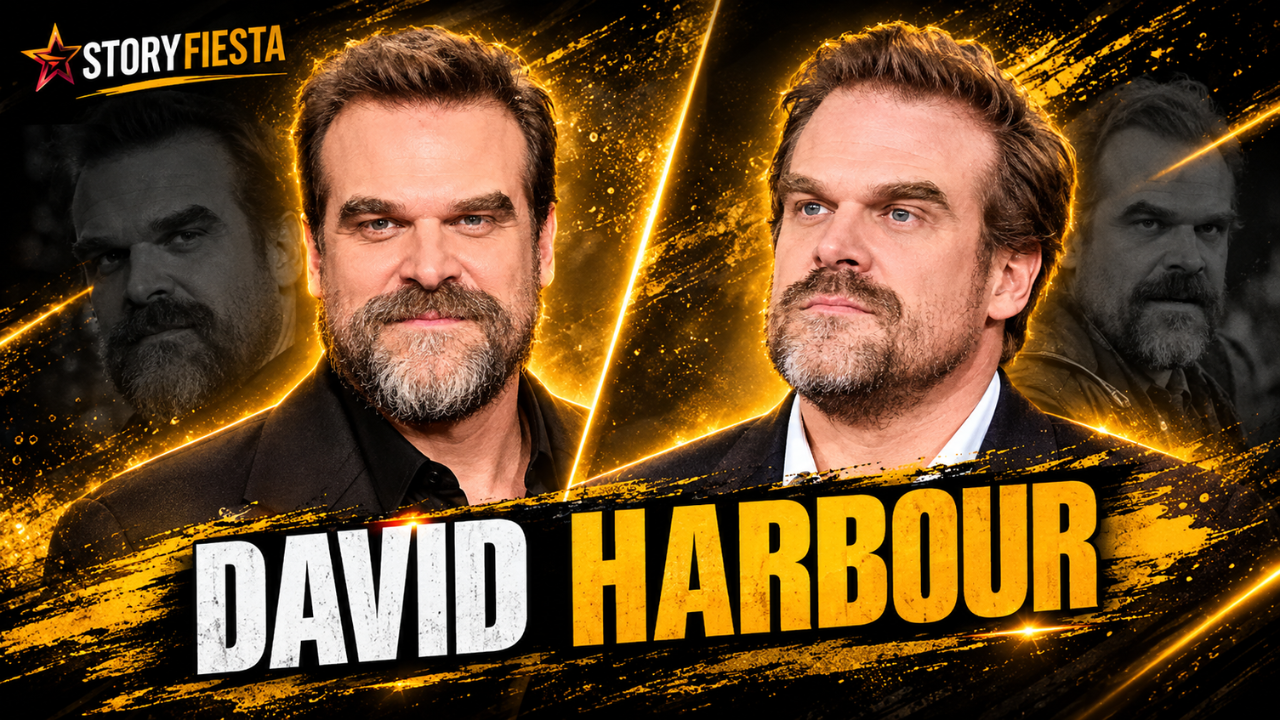
David Harbour’s professional story began long before the period of widespread recognition that made him familiar to a much larger audience. His documented background includes drama study at Dartmouth College, extensive college theater work, a Broadway career dating to 1999, and a Tony Award nomination several years later.
More recently, Harbour has expanded his responsibilities into executive producing. Interviews across different stages of his career also provide a clearer picture of how he thinks about creative work, later-in-life fame, mental health, digital distraction, and professional change.
| Category | Details |
|---|---|
| Education | Dartmouth College, Class of 1997; drama major |
| Broadway record | Professional Broadway career documented by The Broadway League |
| Theater recognition | Tony Award nominee for featured stage work |
| Environmental work | Participated in a Greenpeace Antarctic conservation campaign |
| Producing | Officially credited as an executive producer on an HBO limited series |
| Professional recognition | Television Academy recognition connected with performing and executive producing |
How Dartmouth Theater Shaped His Early Direction
Harbour graduated from Dartmouth College with the Class of 1997, and Dartmouth’s own alum publication identifies him as a drama major. His involvement in theater there went beyond appearing onstage.
During college, he directed productions of Macbeth and Hamlet and participated in other classical and experimental theater work. That record places directing and dramatic study near the beginning of his professional development rather than presenting them as interests he discovered only after becoming well known.
Dartmouth’s documentation is particularly useful because it establishes a structured theatrical background before his professional Broadway years. It also provides an early example of Harbour working on both sides of a production: interpreting material as a performer while also taking responsibility for directing.
How His Broadway Work Built a Professional Foundation
Harbour’s Broadway record begins in 1999, according to the Internet Broadway Database operated by The Broadway League. His credits continued across several major stage productions in the years that followed.
One of the clearest markers of that period came in 2005, when the Tony Awards nominated him for Best Featured Actor in a Play. The nomination gave him significant professional recognition well before his later rise to mainstream fame.
His Broadway history is important to understanding the chronology of his career. By the time a much wider audience became familiar with him, Harbour already had years of professional stage experience behind him.
The available Broadway database does not represent every piece of theater work he has ever done. Still, it provides a documented record of a professional foundation that extends back more than two decades.
Why Later Fame Changed His Perspective on the Profession
Harbour has spoken directly about the unusual timing of his broader public recognition. During a July 2022 appearance on Amanpour & Company, Harbour explained that he appreciated finding widespread recognition later in life, after reaching his 40s.
He tied his reasoning to the years he had already spent living an ordinary adult life without constant public attention. Rather than describing late recognition as a disadvantage, he presented those earlier years as something that gave him perspective before his public profile changed dramatically.
That experience also shaped how he spoke about younger performers. Harbour told Christiane Amanpour that intense attention at a young age can make ordinary experimentation and failure more difficult. In his view, the pressure of becoming a public brand can arrive before a young person has had much room to develop away from scrutiny.
Those comments are best understood as Harbour’s own assessment of fame rather than a general rule about every young performer. They nevertheless explain why the timing of his own success became an important part of how he understands the profession.
How His Creative Priorities Evolved Beyond Performance
By 2025, Harbour was speaking more openly about what he valued in creative work after decades in the profession.
In an April 2025 interview with British GQ, he encouraged younger colleagues to focus on telling stories sincerely rather than judging their worth by follower counts or commercial visibility. He emphasized the quality and honesty of the work rather than the size of the audience around it.
The same interview came during a period Harbour described as one of considerable professional and personal change. He had recently completed a year-long production period tied to a major project that had occupied much of his 40s.
He did not lay out a fixed blueprint for what would follow. He described a transition away from a long-running chapter as his professional responsibilities began to broaden.
His move into producing came during this broader period of professional transition. By 2026, official production records confirmed that executive producing had become part of his work.
How Producing Became Part of His Recent Work
A clear expansion of Harbour’s professional role was officially documented in 2026.
Warner Bros. Discovery and HBO confirmed that he served as an executive producer on a seven-episode limited series that premiered on March 1, 2026. The credit placed him behind the scenes and in the production itself.
The Television Academy later recorded that the limited series won Outstanding Limited or Anthology Series in 2026, with Harbour among its credited executive producers. The Academy also gave Harbour an individual Emmy that year for his work on the same project.
The producing credit therefore represents more than a casual association with a project. Both the distributor and the Television Academy document it.
At the same time, the official material does not specify the exact day-to-day duties Harbour performed as executive producer. It confirms the title and award eligibility, but not a detailed breakdown of his responsibilities.
That distinction keeps the recent development in proportion: Harbour had clearly moved into producing, but the available record does not support claiming that he controlled every creative or managerial decision involved.
What His Public Comments Reveal About Work and Focus
Harbour’s interviews also reveal several practical and philosophical changes in how he approaches work.
In a 2018 appearance on Armchair Expert with Dax Shepard, he spoke directly about having been diagnosed with bipolar disorder in his mid-20s. Accounts differ slightly on whether he was 25 or 26, so the broader age range is the more reliable description.
During that conversation, Harbour rejected the romantic idea that mental illness is necessary for creativity. He separated psychological suffering from artistic ability rather than treating one as the source of the other.
His later interviews show a similar interest in protecting his attention. In a 2025 conversation with Interview Magazine, he said he sometimes replaces his smartphone with a basic flip phone and has kept that arrangement for stretches of four or five months.
He also described a change in his relationship with social media. While he had initially enjoyed sharing more of himself publicly, he said that his Instagram use had become largely focused on professional promotion.
That reduced interest in constant online self-presentation should not be confused with a claim that Harbour avoids public life altogether. In British GQ, he also drew a clearer boundary around tabloid-covered personal matters, declining to discuss details involving other people.
Another part of his reflective routine has included occasional visits to a Buddhist monastery in Escondido, California, connected with an old college friend who became a monk in the tradition of Thích Nhất Hạnh. Harbour described first visiting during a difficult period around age 30 and returning at other points for conversation and perspective.
Those visits document an interest in reflection and Buddhist-influenced practices, but they do not establish a formal religious identity.
How Public Advocacy Fits Into His Broader Career
Harbour’s best-documented advocacy work outside his profession came in February 2018, when he joined Greenpeace aboard the Arctic Sunrise during an expedition to Antarctica.
Greenpeace International was campaigning at the time for an Antarctic Ocean Sanctuary. Harbour did more than appear in promotional material: the organization published comments he made during the trip about how experiencing Antarctica directly changed his understanding of the campaign.
He said that he had initially approached the opportunity with a lighter attitude but came away with a stronger appreciation for preserving an environment he had now experienced firsthand.
The episode is a concrete example of Harbour using his public profile in support of an environmental campaign. The 2018 expedition is a documented example of Harbour supporting an environmental campaign, although the available information does not establish environmental advocacy as an ongoing professional role.
By 2026, Harbour’s professional record extended from his Dartmouth theater background and decades of Broadway work to an officially credited role in executive producing. His interviews also document how later recognition influenced his views on creative work, public attention, and younger colleagues.